


Public Relations FH-USU: Monday (02/12/2024)
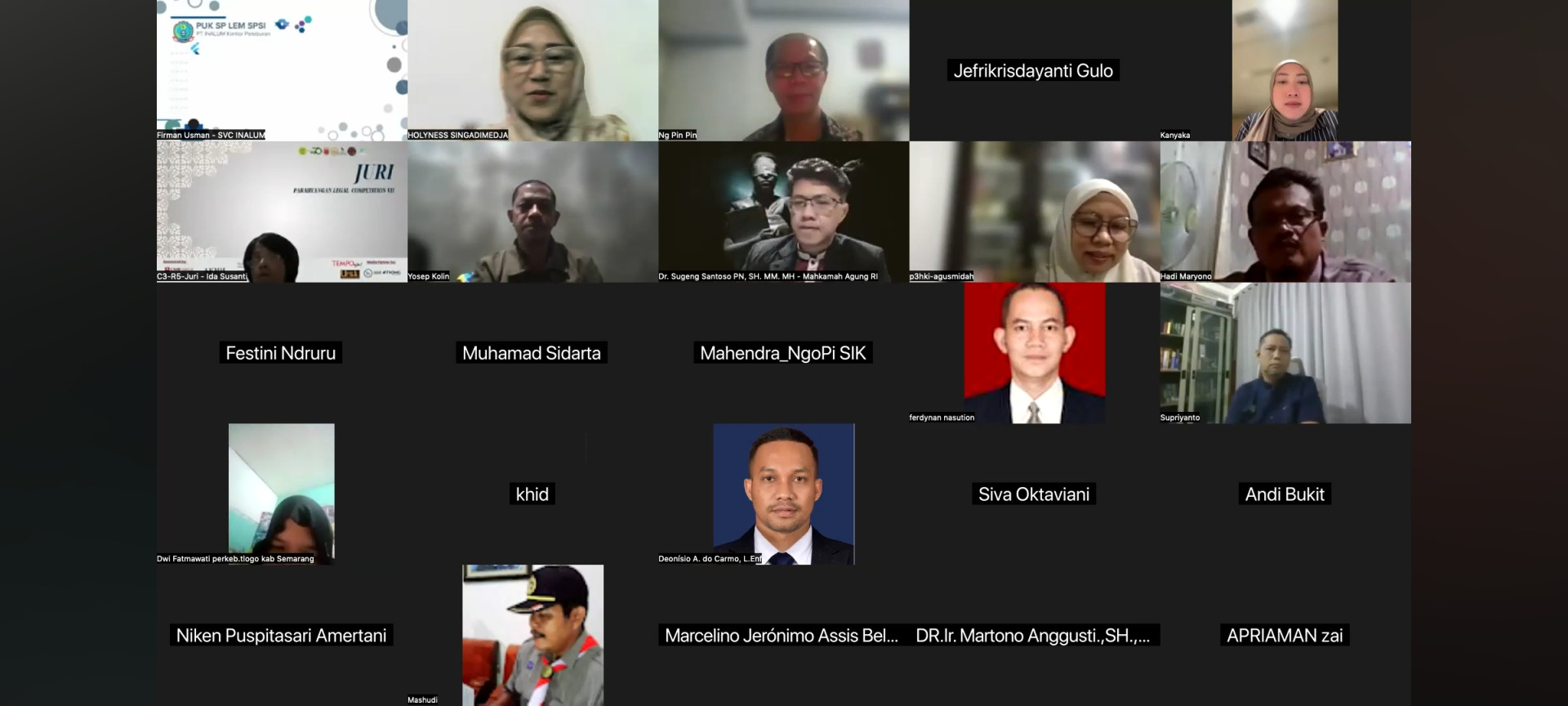
The Association of Indonesian Labor Law Teachers and Practitioners (P3HKI) held Webinar Series 1 of the P3HKI Workshop titled “Peeling the Wage Completion in Indonesia: Challenges and Solutions Towards Wage Justice for Workers and Employers.” Participants from various elements, namely P3HKI Members, APINDO, Workers / Labor Unions, Students, PHI Judges, Labor Mediators, and elements of the P3HKI Supervisory Board, attended this event.
P3HKI Chairperson, Dr. Agusmidah, S.H., M.Hum, who is also an official Deputy I of the USU Faculty of Law in the opening of the event emphasized that this event was P3HKI's contribution to opening a space for discussion on the President's political statement regarding the determination of the minimum wage increase/adjustment. For workers/laborers, of course, this is a breath of fresh air that is expected after several years of minimum wage adjustments being held back by a formula prepared by the government with an accumulation of inflation figures, economic growth, and specific indices set on a scale of 0.1 to 0.3. Then is the president's statement related to the mandate of Constitutional Court Decision No. 168, which confirms that the minimum wage must contain a specific index reflecting the components of a decent life (KHL), said Dr. Agusmidah.
At this event, P3HKI presented speakers from the DPP APINDO North Sumatra Province and the Bogor Federation of LEM SPSI Trade Unions. The speakers were Ng Pin Pin, S.E. (Vice Chairman of the DPP APINDO North Sumatra Province), and Supriyanto (Chairman of the Bogor Federation of LEM SPSI Trade Unions). The event was guided by the Moderator, Dr. Holynes N. Singadimedja, S.H., M.Hum.
In this webinar, P3HKI made a webinar resume as a policy paper for workshop one as follows:
Wage policy must be considered from various angles. It is not an independent variable because the size of the wage will affect the price increase. The company will adjust the production costs it will bear from the wage increase. This will impact the inflation rate and influence the community's purchasing power (and workers are one of the groups in it).
The Minister of Trade's Regulation No. 8 of 2024 on Government Import Policy and Regulation has led to an increasingly open flow of imported goods, especially textile and apparel products. The government should consider how to improve the competitiveness of domestic production and review the policy on imported goods. Business sustainability is one of the critical aspects of sustaining the Indonesian economy and the competitiveness of workers in the domestic job market.
The government must create standards for preparing Wage Structures and Scales to avoid diverse interpretations so that there are standard guidelines for companies and labor unions when negotiating Collective Labor Agreements. In addition, law enforcement requiring companies to have a Wage Structure and Scale is also a crucial matter that can facilitate wage negotiations by employers and labor unions.
It is well recognized that not all employers can pay wages per their region's minimum wage. Therefore, restoring the possibility to postpone the minimum wage as in the legislation before the enactment of the Job Creation Law will be able to provide the possibility for Employers to maintain the sustainability of their business by guaranteeing that workers/laborers will eventually get a shortage of wage payments during the postponement period.
Enforcement of Indonesian labor law through the creation of legal certainty for companies that comply with the rules, imposing strict sanctions on companies that violate the rules and protect workers' rights, and eradicating the high-cost economy that occurs due to the operation of elements in industrial relations that increase production costs (for example, extortion and thuggery practices).
The government must expand employment opportunities and maintain the absorption capacity of existing jobs, given that the demographic bonus will hit Indonesia in 2025-2030. Strategic steps are needed to anticipate the impact of the demographic bonus and the utilization of technology to keep Indonesia's human resources competitive in quantity and quality.