


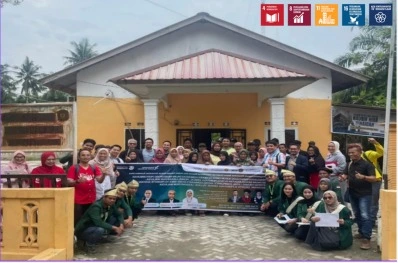
HUMAS FH-USU: On Saturday (27/06/2026), the Master's Program in Law, Faculty of Law, Universitas Sumatera Utara (FH USU), collaborated with academics from Malaysia and several Indonesian universities to strengthen the legal literacy of Micro Enterprise (ME) owners in Pematang Cengal Village, Tanjung Pura District, Langkat Regency.
This international community service program aims to improve legal compliance, strengthen business governance, and enhance the economic resilience of local communities following the devastating floods. The initiative, held on Saturday (27/6), forms part of a broader community service program conducted from May to July 2026, focusing on strengthening the legal compliance of Micro Enterprise (ME) owners in flood-prone areas.
Pematang Cengal Village was selected as the program location because it was among the areas severely affected by the major floods that struck Sumatra in 2025. Through this Indonesia–Malaysia collaboration, the initiative seeks to develop a community-based legal empowerment model that can be implemented in villages across Indonesia.
The Head of the Organizing Committee, Lesly Saviera, S.H., M.H., from the Faculty of Law, Universitas Sumatera Utara, explained that the program aims to enhance the understanding of Micro Enterprise (ME) owners regarding the importance of business legality, regulatory compliance, and the implementation of good business governance to improve business competitiveness and resilience.
The program featured Associate Professor Badruddin Bin Hj. Ibrahim from the Ahmad Ibrahim Kulliyyah of Laws, International Islamic University Malaysia (IIUM), who presented best practices in community-based legal empowerment for micro, small, and medium enterprises (MSMEs) in Malaysia.
In addition, academics from the Faculty of Law, Universitas Padjadjaran, Agus Suwandono, S.H., LL.M., and Dr. Deviana Yuanitasari, S.H., M.H., delivered presentations on legal compliance, business legality, consumer protection, business governance, and strategies for strengthening the resilience of MSMEs in responding to economic and disaster-related risks.
The event was also attended by academics from the Faculty of Law, Universitas Brawijaya, and Universitas Terbuka. A total of 25 residents of Pematang Cengal Village engaged in various micro and small businesses, ranging from culinary enterprises to retail businesses, participated in the program.
The implementation of the community service program was supported by students participating in the USU Thematic Community Service Program (KKN), who served as both organizing committee members and field facilitators. They were involved in coordinating with the Pematang Cengal Village Government, participant registration, facilitating group discussions, documentation, and program evaluation as part of an experiential learning process.
The collaboration among universities, the village government, the local community, students, and international partners represents a tangible implementation of the university's Tri Dharma while supporting the achievement of the Sustainable Development Goals (SDGs), particularly SDG 4 (Quality Education), SDG 8 (Decent Work and Economic Growth), SDG 11 (Sustainable Cities and Communities), SDG 16 (Peace, Justice and Strong Institutions), and SDG 17 (Partnerships for the Goals).
Through this initiative, the organizers hope to establish a community-based legal empowerment model for Micro Enterprises (MEs) that strengthens legal compliance, enhances rural economic resilience, and serves as a best practice for community development in regions across Indonesia.