


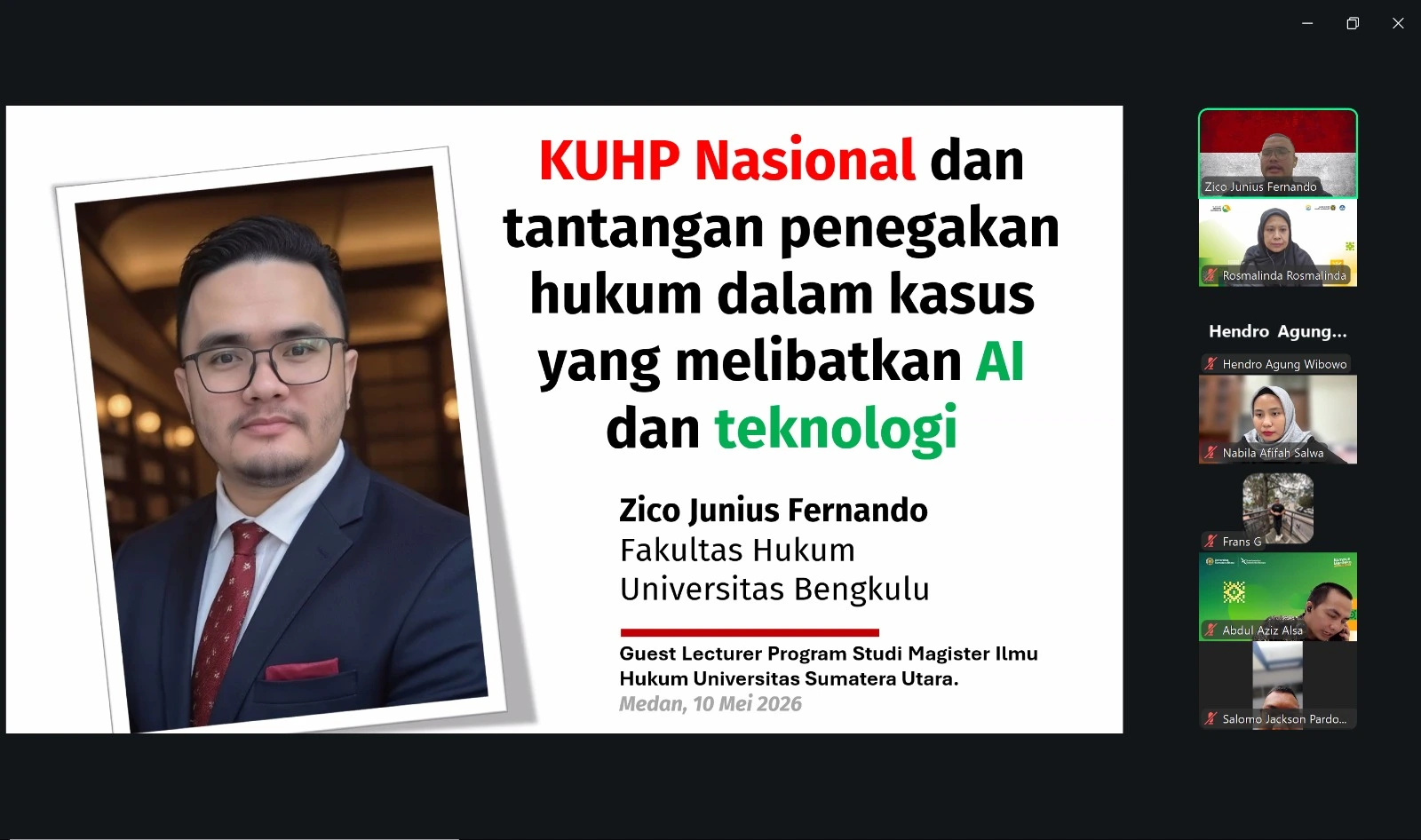
PUBLIC RELATIONS FH-USU: Monday (11/05/2026) — The Master of Law Program at the University of North Sumatra organized a Guest Lecture themed “The National Criminal Code and Law Enforcement Challenges in Cases Involving AI and Technology.” The academic event was conducted with great enthusiasm and attended by around 100 participants consisting of students and lecturers.
The event was moderated by Dr. Abdul Aziz Alsa, S.H., M.H., and featured Dr. Zico Junius Fernando, S.H., M.H., CIL., C.Med., C.L.A. (Lecturer at the Faculty of Law, University of Bengkulu) as the keynote speaker. He discussed the dynamics of national criminal law enforcement amid the rapid development of artificial intelligence (AI) and digital technology.
The Guest Lecture was officially opened by the Secretary of the Master of Law Program at USU, Dr. Mahmud Mulyadi, S.H., M.Hum. In his remarks, he emphasized the importance for law students to understand law enforcement in cases involving AI and technology, considering that digital technological advancements increasingly influence various aspects of society and the national legal system.
In his presentation, Dr. Zico Junius Fernando explained that Law Number 1 of 2023 concerning the Indonesian Criminal Code (National Criminal Code) has provided a strong normative foundation for handling cases involving artificial intelligence and technology. This foundation is reflected through the paradigm of legal decolonization based on Pancasila values and human rights, the strict principle of legality as stipulated in Article 1, cross-border digital criminal jurisdiction under Articles 4 to 9, the framework of participation in criminal acts under Articles 13 to 21, corporate liability provisions under Articles 45 to 50, as well as regulations concerning information and electronic crimes such as unauthorized access and system destruction as stipulated in Articles 332 to 334.
Furthermore, the speaker emphasized that artificial intelligence is positioned merely as a medium rather than a legal subject. Therefore, law enforcement efforts must focus on precise criminal qualification, digital forensic-based evidence, and the attribution of responsibility to human actors and corporate entities.
Nevertheless, several challenges remain in its implementation, including the complexity of multi-actor chains, the black box model characteristics of AI systems, and issues related to international jurisdiction coordination. To address these challenges, reforms are needed in the form of official interpretative guidelines, special evidentiary standards related to AI, strengthening the capacity of law enforcement officers, and harmonization with various sectoral laws to create adaptive law enforcement without compromising legal certainty.
The event proceeded interactively through discussion and question-and-answer sessions, which received enthusiastic responses from students. Participants raised various critical questions regarding the position of AI in criminal law, digital evidence, and corporate responsibility in technology-based crimes.
Through this activity, the Master of Law Program at USU hopes to broaden students’ academic perspectives and encourage the development of legal studies that are responsive to technological advancements and digital transformation in Indonesia.