


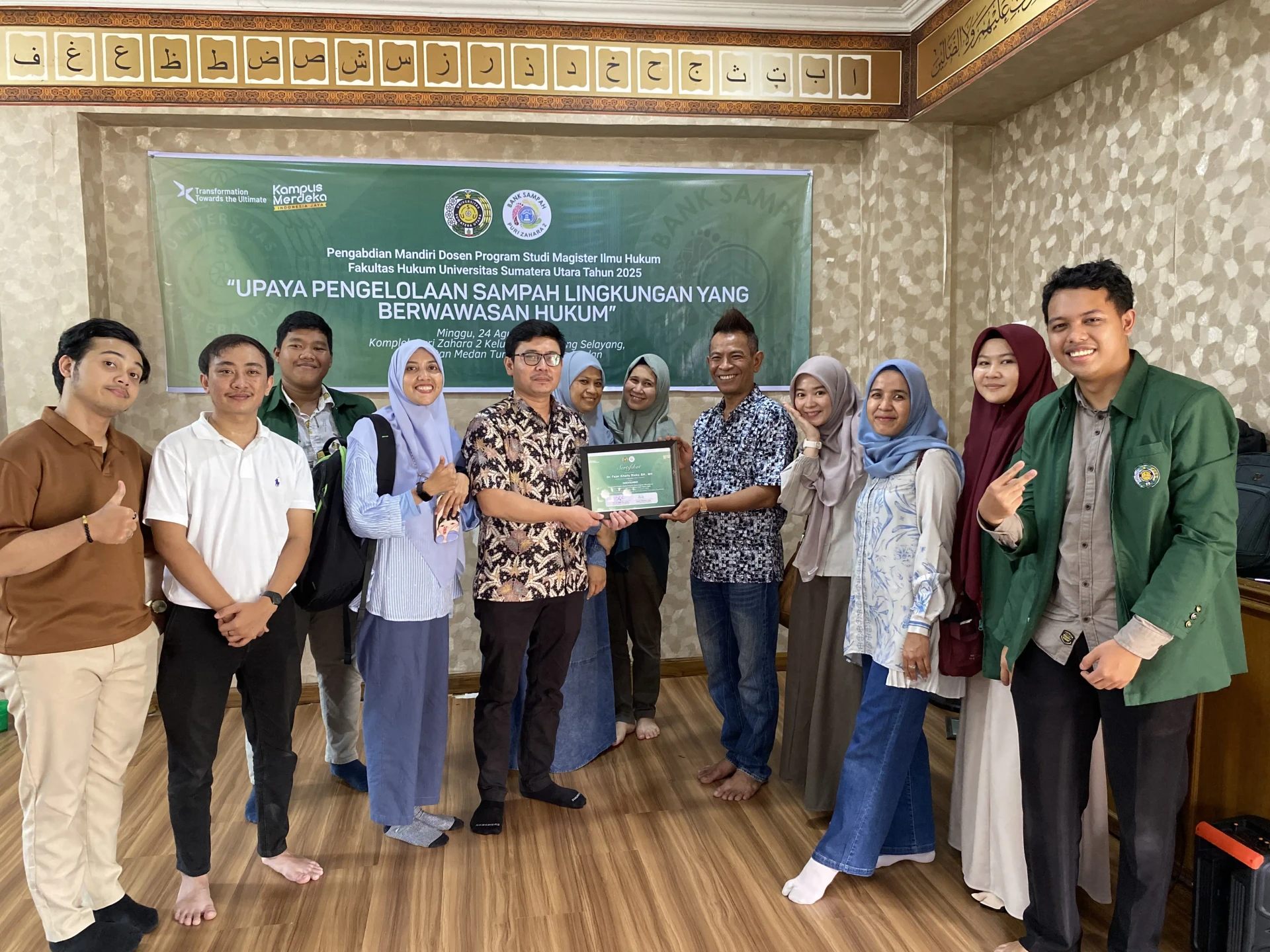
Public Relations FH-USU: Sunday (August 24, 2025), to promote waste management in Medan City, lecturers and students of the Master of Law Program, Faculty of Law, Universitas Sumatera Utara (MIH FH USU) held an Independent Lecturer Community Service (PkM) activity at the Puri Zahara II Waste Bank Office, located in Puri Zahara II Complex, Simpang Selayang Subdistrict, Medan Tuntungan District.
In this activity, the Dean of the Faculty of Law USU, Dr. Mahmul Siregar, S.H., M.Hum., was present, as well as the Head of the MIH FH USU Program, represented by Dr. Mahmud Mulyadi, S.H., M.Hum., in his capacity as Secretary of the MIH FH USU Program.
This activity was also attended by lecturers of the Faculty of Law USU, such as Dr. Rosmalinda, S.H., LL.M., Dr. Syarifah Lisa, S.H., M.Hum., Siti Khairunnissa, S.H., M.H., and Lesly Saviera, S.H., M.H., along with the MIH FH USU community service team and MIH FH USU students. The event was also attended by the Head of Simpang Selayang Subdistrict, the local neighborhood head, and the elders of the complex. In his remarks, the Head of Simpang Selayang Subdistrict expressed his gratitude for this independent lecturer community service activity related to the waste bank. He conveyed his hope that this activity could bring benefits to the community.
The Director of Puri Zahara II Waste Bank, Jamaliyah Pattimura, S.Hut., expressed her appreciation for this activity. “Alhamdulillah, this program is very good. If we equip ourselves with knowledge, it will strengthen us. Therefore, we truly appreciate this activity and express our deepest gratitude for the independent community service conducted by the Master of Laws Program, Universitas Sumatera Utara.”
The Dean of the Faculty of Law USU, Dr. Mahmul Siregar, S.H., M.Hum., in his remarks, stated that this community service must be carried out continuously and should create a sustainable impact. “This activity must generate lasting benefits for the community,” he emphasized.
The Dean also highlighted the problems concerning the cleanliness of Medan City. He called on everyone to work together to address the waste issue in the city.
At the same occasion, Dr. Mahmud Mulyadi, S.H., M.Hum., who also served as the Head of the Community Service Team, expressed gratitude that the program could be held. “This activity is carried out based on the tri dharma of higher education, one of which is research and community service.”
The event featured competent speakers in their fields, who are lecturers of the Faculty of Law USU, including Dr. Vita Cita Emia Tarigan, S.H., LL.M., and Dr. Fajar Khaify Rizky, S.H., M.H., who delivered material related to legal perspectives on environmental waste management.
The program continued with an interactive two-way discussion between the speakers and the participants. The first speaker, Dr. Vita Cita Emia Tarigan, emphasized that waste bank activities reflect an excellent form of community awareness that must be implemented with consistency. She also highlighted that waste has become a very concerning issue.
In her presentation, she explained that Indonesia produces more than 67 million tons of waste per year. This is highly alarming as it contributes to global warming. The problem is caused by cultural habits in society, such as the tendency to burn waste or the lack of awareness of the harmful impacts of littering, which causes global warming.
Dr. Vita Cita also explained that the most frequent disposal site for waste is the sea. This is supported by several sources and concrete evidence indicating that Indonesia has become a dumping ground for global waste. This term illustrates how waste has become a major problem in Indonesia, particularly in the city of Medan. Dr. Vita Cita emphasized the principle of sustainable waste management and the role of local government regulations on waste management. These roles include regulation, infrastructure, education, and partnerships. Such partnerships are built through collaboration with the private sector, NGOs, and communities for the implementation of integrated waste management programs. The private sector’s role in this context is carried out through CSR (Corporate Social Responsibility).
In the course of her presentation, Dr. Vita Cita highlighted the main legal basis for Corporate Social and Environmental Responsibility (TJSL/CSR) in Indonesia, namely Law No. 40 of 2007 on Limited Liability Companies (Company Law), particularly Article 74, as well as Government Regulation No. 47 of 2012 (GR 47/2012). The Company Law requires companies engaged in natural resource–based businesses to implement CSR, while GR 47/2012 provides details on implementation and reporting obligations. Although sanctions for violations are not explicitly regulated under the Company Law and GR 47/2012, they may refer to other laws such as the Investment Law.
The second speaker, Dr. Fajar Khaify Rizky, S.H., M.H., explained that environmental management requires the participation of the community, waste bank managers, the government, and all elements of society. Dr. Fajar emphasized that the community has obligations in managing the environment. These obligations include maintaining the environment, controlling environmental pollution, providing information related to environmental protection and management in a proper, accurate, transparent, and timely manner, ensuring the sustainability of environmental functions, and complying with environmental regulations.
Dr. Fajar also reminded that the harmful effects of improper waste disposal include causing disease, polluting the environment, and triggering disasters such as flooding due to clogged drains and overflowing rivers caused by accumulated household waste. “In society, aesthetics are important, and therefore, the obligation of the community to protect the environment also aims to maintain its aesthetic value. Regulations on waste management are stipulated in Law No. 18/2008 on Environmental Waste Management and Minister of Environment and Forestry Regulation No. 13/2012 on Guidelines for the Implementation of Reduce, Reuse, and Recycle through Waste Banks,” Dr. Fajar explained.