


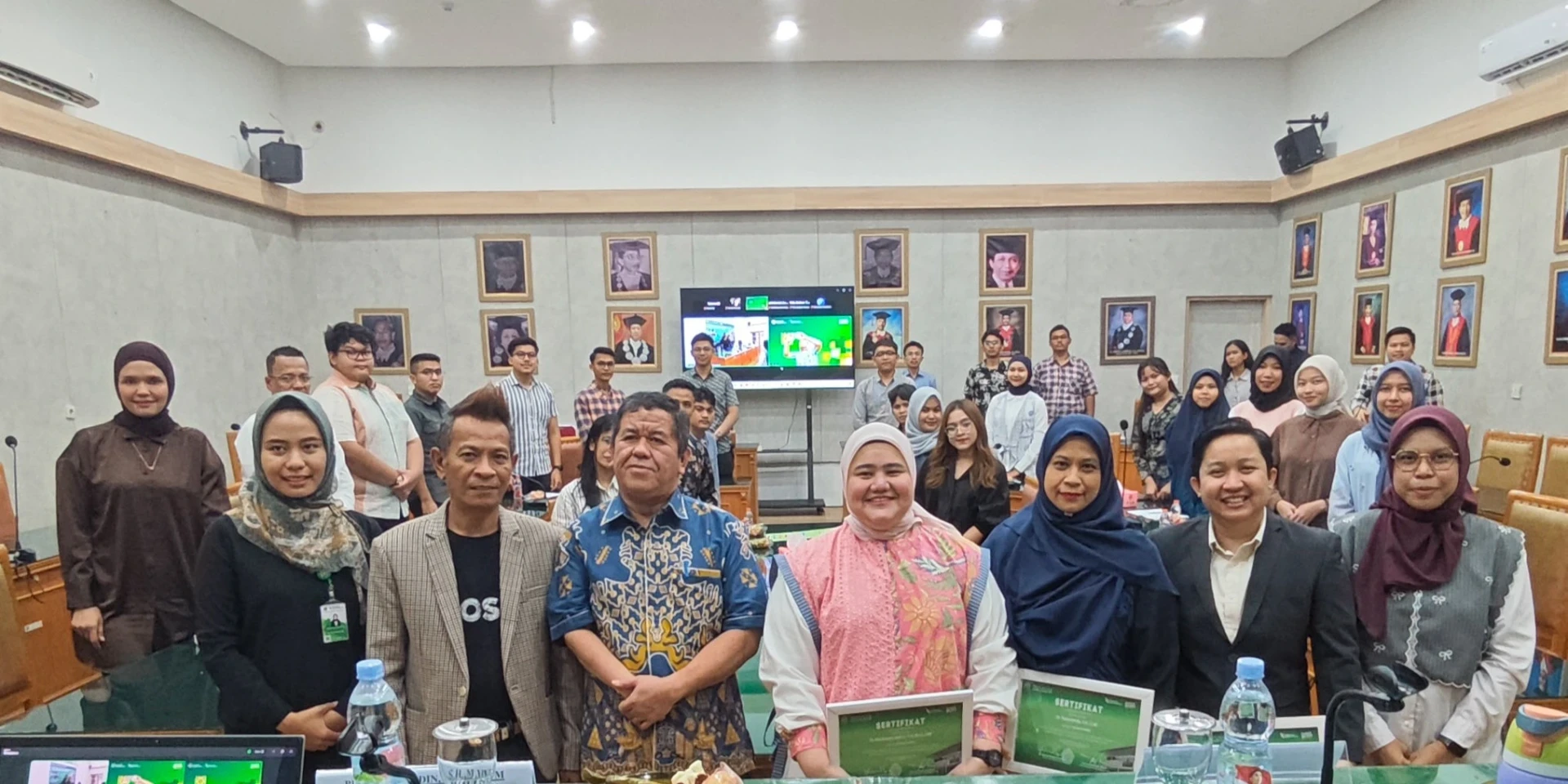
FH USU-Public Relations: Thursday (16/10/2025), the Master’s Program in Law, Faculty of Law, Universitas Sumatera Utara (FH USU), successfully held a Legal Negotiation Skills Training for Dispute Resolution. The training, conducted in the DPF Room of FH USU, aimed to equip students with negotiation abilities, enabling them to face the challenges of legal practice with a solution-oriented and cooperative approach.
The event featured two main speakers: Dr. Montayana Meher, S.H., M.Kn., CIM (Secretary of IMAC Medan Representative) and Dr. Rosmalinda, S.H., LL.M (Lecturer at the Faculty of Law, USU). The session was moderated by Agatha Kurniati, S.Int., CIM (Treasurer of IKA IMAC Medan Representative).
The event was officially opened by the Dean of FH USU, Dr. Mahmul Siregar, S.H., M.Hum. In his remarks, Dr. Mahmul Siregar emphasized the importance of mastering skills and competencies amid rapid technological developments. He highlighted data from the World Economic Forum predicting that artificial intelligence (AI) will replace up to 24% of human jobs in 2024 and is expected to reach 44% by 2030. Therefore, negotiation skills are becoming a crucial foundation for competition, enabling alumni to compete and obtain resources effectively through cooperative negotiation models.
Remarks were also delivered by the Secretary of the Master’s Program in Law, FH USU, Dr. Mahmud Mulyadi, S.H., M.Hum, who explained that the current job market demands law graduates with practical skills. “The market needs law graduates who possess skills so that they have expertise. In the field, regardless of the profession, they should have practical abilities and be able to join IMAC, BANI, or others. Many disputes are resolved through win-win solutions and harmonized dispute settlement. Disputes may arise, but there is always a path to resolution,” he explained.
Dr. Montayana Meher presented various advantages of legal negotiation, including:
Faster and more efficient than litigation
Low cost
Maintains business or personal relationships
Flexible and adaptable to the parties’ needs
Confidential, unlike court proceedings
Meanwhile, Dr. Rosmalinda explained the differences between commercial and non-commercial negotiations. Commercial negotiations focus on efficiency and profit, whereas non-commercial negotiations prioritize humanitarian values and social sustainability. In the context of marginalized communities, legal aid is essential to address power imbalances, with participation and substantive justice as key principles.
Moderator Agatha Kurniati also added perspectives on artificial intelligence (AI), noting that AI sometimes provides less optimal advice in technical aspects. She emphasized the importance of negotiation in HR and business fields, particularly in mediation and arbitration settings.
The interactive discussion, involving students of the Master’s Program in Law, USU, lasted for two hours, allowing participants to deepen their understanding of negotiation techniques and strategies for dispute resolution in various contexts. The session concluded with an enthusiastic Q&A, demonstrating the students’ strong interest in developing dispute resolution skills outside the litigation pathway.