


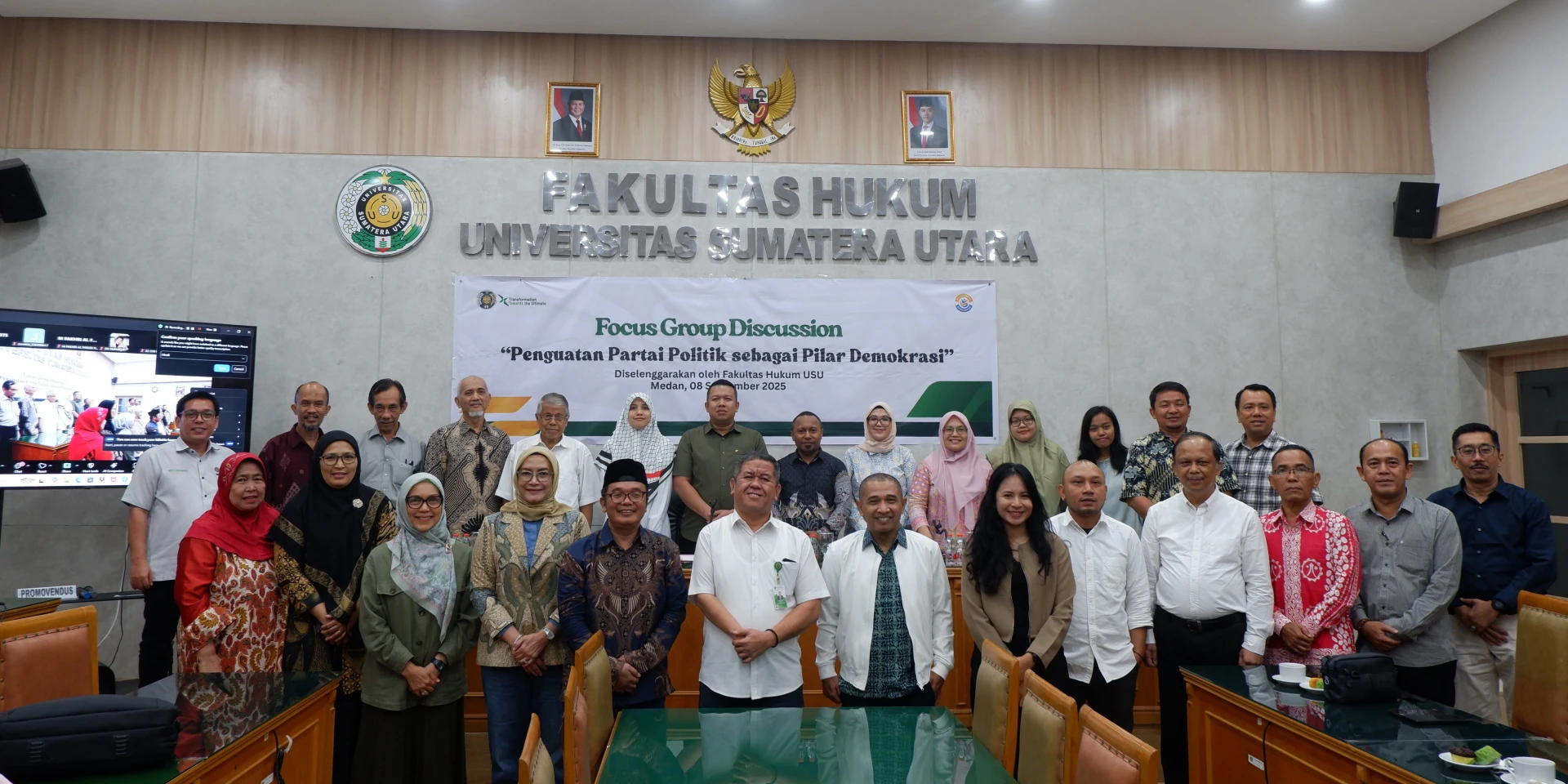
Monday (September 8, 2025) — The Faculty of Law, Universitas Sumatera Utara (FH USU), organized a Focus Group Discussion (FGD) titled “Strengthening Political Parties as Pillars of Democracy.” The forum gathered cross-disciplinary academics to discuss the essential problems faced by political parties and to craft recommendations aimed at enhancing Indonesia’s democracy.
The discussion featured several academic speakers, including Dr. Mirza Nasution, S.H., M.Hum., who presented “Recruitment of Political Party Leaders: Toward Democratic and Meritocratic Selection,” Dr. Faisal Akbar Nasution, S.H., M.Hum., who discussed “Governance of Regional Elections and Legislative Elections (Provincial and Regency/City DPRD),” and Dr. Warjio, M.A., Ph.D., who examined “Political Party Funding in Indonesia: Regulations, Challenges, and Reform Prospects.” The session was moderated by Devi Yulida, S.H., M.H.
In his opening remarks, the Dean of FH USU, Dr. Mahmul Siregar, emphasized the importance of the forum in generating new ideas amid the ongoing discourse on the Political Omnibus Law being deliberated by the government and the House of Representatives. According to him, reforming party regulations should go beyond electoral system management and also strengthen the functions of representation, political education, and party cadre development. During the discussion, the experts highlighted three major issues still constraining political parties: cadre recruitment mechanisms, electoral governance, and party funding. The cadre recruitment process is still far from meritocratic principles, often prioritizing loyalty and personal connections over competence and integrity.
Furthermore, the nomination processes for legislative and regional leadership positions remain opaque and vulnerable to transactional practices, leading the public to question the quality of political representation provided by parties. Party funding also remains a weak point, opening the door to conflicts of interest and further damaging public trust in political institutions. A total of 25 academics participated actively in the discussion, contributing critical insights and constructive recommendations. Representatives from the media also attended, including Devis Abuimau Karmoy, M.Ikom., from the online news outlet Dailyklik.id. The FGD outcomes are expected to serve as a tangible contribution to political reform in Indonesia, ensuring that political parties can truly stand as strong, transparent, and people-oriented pillars of democracy.