


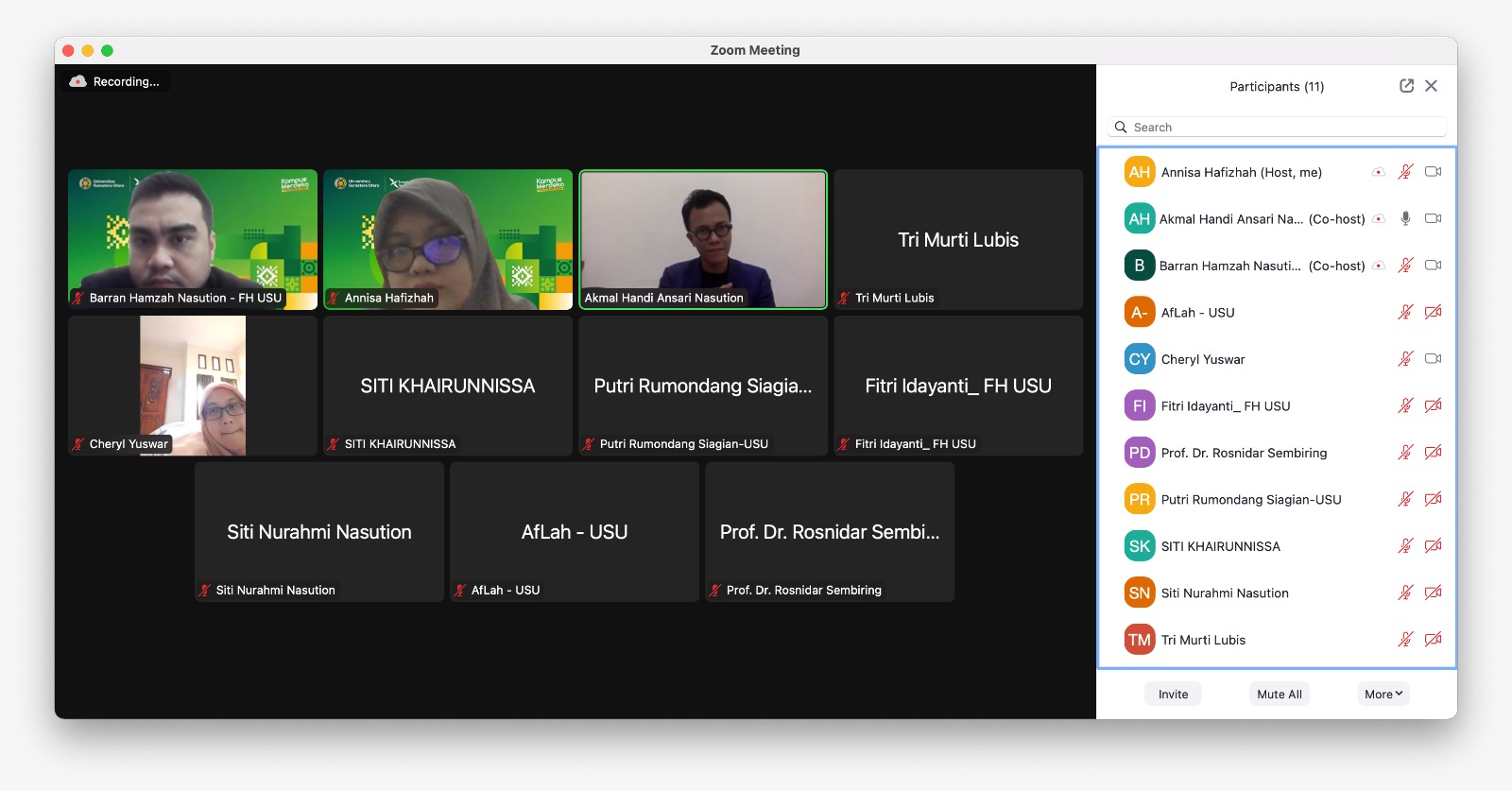
Public Relations FH-USU: On Friday (12/01/2024), the Faculty of Law at Universitas Sumatera Utara (FH USU) conducted an Adjunct Professor activity as part of the EQUITY Program, featuring Assoc. Prof. Akmal Handi Ansari Nasution from OP Jindal Global University, India. The session commenced with the topic "Interdisciplinary Approach to International Law," marking the beginning of a series of Adjunct Professor activities.
The event was facilitated by FH USU lecturers Barran Hamzah Nasution, SH., M.CL, and Annisa Hafizhah, S.H., M.H., who acted as hosts. Assoc. Prof. Akmal introduced a new research method, namely the interdisciplinary approach, which can be applied in legal research, particularly in international law and economic law. These areas are known for their high complexity due to their close connection to various legal subjects, diverse legal substances in different legal systems, and various other aspects.
Assoc. Prof. Akmal also introduced TWAIL, which stands for Third World Approaches to International Law. It is a movement aimed at challenging the aspects of oppression in international law by re-examining the colonial foundations of post-World War II international law. The Asia-Africa Conference held in Bandung, Indonesia, in 1955 is recognized as the birthplace of TWAIL. During this conference, African and Asian countries united to address the issues faced by the Third World (i.e., developing countries).
The main goals of TWAIL include building an understanding of how international law continues to subordinate non-European nations to European nations through international legal norms, creating opportunities for Third World participation in international law, proposing alternative international legal mechanisms that stand alongside critiques of the neoliberal approach to international law, eradicating poverty in the Third World through education, policies, and politics, and understanding and involving Third World education in the analysis of international law.