


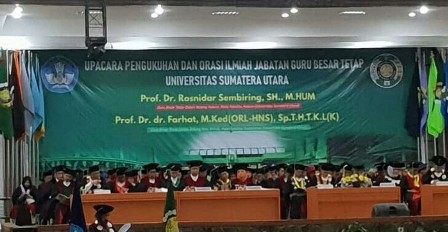
Public Relations FH-USU: Monday (17/02/2020)
Universitas Sumatera Utara held the Inauguration of Permanent Professor in Law to Prof. Dr. Rosnidar Sembiring, S.H., M. Hum – currently the Head of the Department of Civil Law, Faculty of Law, Universitas Sumatera Utara. The inaugural speech was entitled Actualization of Customary Law Communities: Challenges and Local Wisdom of Global Excellence.
First of all, he said that customary law communities are communities that arise spontaneously in certain areas, whose establishment is not determined or ordered by a higher authority or other authority, with a very great sense of solidarity among its members, who view non-members of the community as outside members and use their territory as a source of wealth that can only be fully utilized by its members. Where legally and constitutionally, the recognition of the existence of customary law communities has been stated in the body of the 1945 Constitution of the Republic of Indonesia (hereinafter referred to as the "1945 Constitution of the Republic of Indonesia") after the amendment, namely in Article 18 B paragraph (2) which states that "The State recognizes and respects customary law community units along with their traditional rights as long as they are still alive and by the development of society and the principles of the Unitary State of the Republic of Indonesia, which are regulated by law." Then Article 18 B paragraph (2) of the 1945 Constitution of the Republic of Indonesia requires that the recognition and respect of Indigenous Peoples and their traditional rights be regulated by law. There are four requirements for the existence of indigenous communities according to Article 18 B paragraph (2) of the 1945 Constitution of the Republic of Indonesia, including: (a) As long as they are still alive; (b) Following the development of society; (c) Principles of the Unitary State of the Republic of Indonesia; (d) Regulated by law.
Regarding the four requirements in Article 18B paragraph (2) of the 1945 NRI Constitution, Satjipto Rahardjo thinks this is a form of hegemonic state power that determines whether or not indigenous peoples exist. In line with the previous opinion, Soetandyo Wignjosoebroto stated that the four requirements, both ipso facto and ipso jure, would be easily interpreted as a requested 'recognition,' with the burden of proof of the continued existence of the Indigenous peoples by the Indigenous legal community itself, with the policy to unilaterally recognize or not recognize being in the hands of the central government.
Respect and recognition of the existence of customary rights managed with local wisdom as human rights are also implicitly regulated in Article 28 I paragraph (3) of the 1945 Constitution of the Republic of Indonesia, that cultural identity and the rights of traditional communities are respected in line with the development of the times and civilization, then in the results of the fourth amendment to the 1945 Constitution of the Republic of Indonesia, in Article 32 paragraph (1) that the State advances Indonesian National Culture amid world civilization by guaranteeing the freedom of society to maintain and develop its cultural values.
In the same fate as the recognition and respect for conditional Indigenous communities, which is stated in Article 18 B paragraph (2) of the 1945 Constitution of the Republic of Indonesia, the mandate of respect and recognition of the existence of customary rights of Indigenous legal communities given by Article 28 I paragraph (3) of the 1945 Constitution of the Republic of Indonesia is still far from being implemented by the State. One of the triggers is the destruction of forest functions, which impacts the development of vertical and horizontal conflicts, conflicts between Indigenous legal communities and immigrants, and conflicts between Indigenous legal communities themselves because forests for Indigenous legal communities are their habitat. Various provisions as a legal basis for the recognition and protection of customary land managed with local wisdom as the rights of Indigenous legal communities have been established, but in reality, these provisions have not been able to resolve customary land conflicts that have arisen in various regions.
Hopefully, his attention to the lack of recognition and respect received by Indigenous legal communities, which was stated in the inaugural speech of this Permanent Professor, can also be a concern for the government, both central and the North Sumatra provincial government. It is hoped that the Omnibus Law on investment proposed by the government must begin with the recognition, protection, and fulfillment of the rights of indigenous legal communities over their territories and agrarian resources. The ratification of the Indigenous Legal Community Law can be used as an entry point for the Omnibus Law on Indigenous Legal Communities by revoking the provisions regulating Indigenous legal communities in various sectoral regulations, which are the leading cause of the marginalization of Indigenous legal communities from enjoying their traditional rights. These sectoral laws have resulted in conflicts and inconvenience in the investment climate, reduced the right to access management of natural resources, and are vulnerable to causing poverty for Indigenous communities.
Therefore, it is time for the State to provide proper recognition of the existence of Indigenous communities for the sake of legal certainty and to realize good governance of Indigenous institutions. As a representative institution of the people, the DPR RI is expected to play a role in forming and ratifying the Bill on Indigenous Legal Communities so that legal issues regarding violations of Indigenous peoples' rights can be resolved. The ratification also aims to realize regional development policies that respect, protect, and fulfill the rights of indigenous peoples. This way, the ideals of a prosperous, just, and sustainable middle-high-income Indonesia can be realized.