


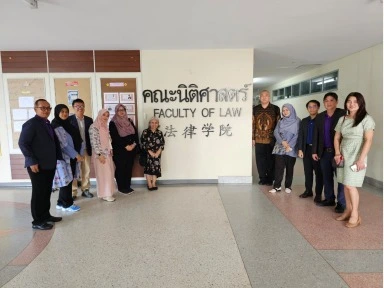
Public Relations FH-USU: On Monday to Thursday (August 25-28, 2025), as part of the implementation of international collaboration, lecturers, students, and alumni of the Faculty of Law, Universitas Sumatera Utara (FH USU) carried out a Field Research under the 2025 International Collaboration Scheme, titled “Legal and Economic Implications of Homestay Tourism: A Policy Learning Study from Indonesia, Malaysia, and Thailand.” This research is a collaboration among Universitas Sumatera Utara, Universiti Teknologi MARA (UiTM) Penang Branch, Malaysia, and Hatyai University, Thailand.
The field research was joined by the Principal Investigator from Universitas Sumatera Utara, Prof. Dr. Ningrum Natasya Sirait, S.H., M.LI, with members Dr. Rosmalinda, S.H., LL.M., and Dr. Robert, S.H., M.H. It also involved USU’s Doctoral Program in Law student Lesly Saviera, S.H., M.H., and USU Master of Law alumna Indira Dina Shabrina Siahaan, S.H., M.H. In addition, the research included members from partner universities, namely Assoc. Prof. Dr. Azila Azmi (Faculty of Hotel and Tourism Management, Universiti Teknologi MARA Penang Branch (Address: Permatang Pauh Campus, 13500 Permatang Pauh, Pulau Pinang, Malaysia)) and Dr. Wachara Chaiyakhet, M.Sc. (Deputy Head of the Tourism Industry Program, Hatyai University, Thailand).
The field research was conducted from 25-28 August 2025 with the following objectives; 1) To analyze the understanding and responses of homestay providers and tourism stakeholders toward the legal framework governing the homestay tourism sector in Indonesia, Malaysia, and Thailand; 2) To evaluate the economic impact of homestay tourism practices on the livelihoods of local communities, particularly in the context of informal practices and differences in legal regulations across the three countries; and 3) To identify and formulate policy lessons from the legal and economic experiences of Indonesia, Malaysia, and Thailand as a basis for developing more sustainable, inclusive, and community-oriented homestay regulations.
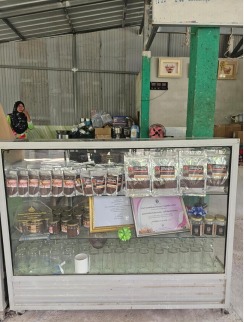
The field research was carried out in two locations facilitated by Hatyai University, Thailand. The first was Satun Village, Thailand, which applies Community-Based Tourism Development (CBT). All of the village’s residents (100%) are Muslim, and therefore the tourism management policies are agreed upon collectively by the community. Tourism management in the village faces no significant obstacles, as the chosen legal entity for managing tourism is the Agricultural Cooperative. This choice is based on the fact that most of the villagers are farmers, including coffee growers, with coffee serving both as a local souvenir and a specialty offered to visiting tourists.
One key takeaway from this field research was related to the enforcement of village policies for foreign tourists, such as those from several European countries. Visitors are required to follow local regulations for instance, dressing modestly and ending activities after the evening (Isha) prayer.
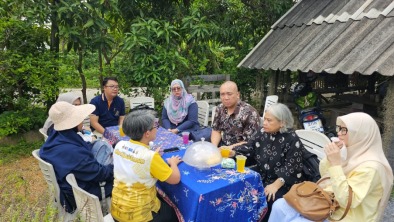
Another notable feature is the presence of a Community Lodge (a homestay facility managed by the community) and an emergency clinic that is particularly women- and child-friendly. This clinic is managed by Miss Adcharilya Malinee, the daughter of the community association leader. The next field research was conducted on 26 August 2025 in Songkhla Village, Thailand. Dr. Wachara Chaiyakhet, M.Sc (Deputy Head of the Tourism Industry Program, Hatyai University, Thailand) explained that, unlike Satun Village where all residents are Muslim, this village is predominantly Buddhist, with the community’s main source of income also being agriculture.
The field discussion was also attended by the Vice President of Hatyai University, who conveyed that their research and community assistance programs were carried out in collaboration with Prince of Songkla University. The community assistance program, using CBT (Community-Based Tourism) as its development model, has been implemented in this village for two years. At the time of the field visit, the community was gathered to receive support from the Thai Government’s Department of Agriculture in relation to this program.
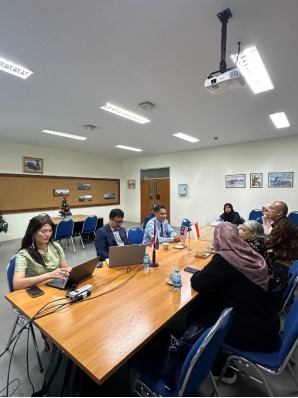
Field Research and Potential for International Collaboration continued the following day, 26 August 2025, with the research team holding a meeting at Hatyai University. This meeting aimed to discuss the formulation of Research Problem 1 of the international collaboration project, which focuses on regulations and policies related to the management of Homestay and CBT. Dr. Wachara Chaiyakhet, Didyasarin International College, Hatyai University, Songkhla, Thailand, explained that CBT is designed to empower local communities, enabling them to independently manage destinations, products, and tourism services.
As a result, the economic, social, and cultural benefits are directly enjoyed by local residents as well as international tourists. CBT is established based on community awareness to advance their region. Therefore, villagers actively participate in decision-making and development direction, preserve local identity and culture, foster intercultural learning, and ensure income distribution for the benefit of the wider community.
Specifically, the presentation on CBT highlighted its connection with several laws and regulations, including: 1) National Park Act, B.E. 2562 (2019); 2) National Reserved Forests Act, B.E. 2507 (1964); 3) Navigation in Thai Waters Act, B.E. 2456 (1913); 4) Tourism Business and Tour Guide Act, B.E. 2551 (2008); 5) Community-Based Tourism (CBT) Standard of DASTA; 6) Community-Based Tourism – CBT Thailand; 7) ASEAN Community-Based Tourism Standard; and 8) Homestay Standard. It was emphasized in particular that the Tourism Business and Tour Guide Act, B.E. 2551 (2008), Article 51, provides the basis for promoting tourism in specific areas or local communities once such areas are designated by the Committee.
This session was also attended by the President of Hatyai University, Asst. Prof. Dr. Wittawat Didyasarin Sattayaraksa, and the Dean of the Faculty of Law, Asst. Prof. Wara Bunphan. The meeting is expected to serve as the starting point for international collaboration between Universitas Sumatera Utara and Hatyai University, particularly within the Faculty of Law. At the conclusion of the field research, the lead research team from Universitas Sumatera Utara, together with its partner Universiti Teknologi MARA, Penang Branch, reached an initial understanding (MoU) to proceed with a formal cooperation agreement through an online signing process by exchanging documents. It is hoped that this collaboration can be further developed in the future to achieve the advancement of higher education.