


Public Relations FH-USU: Friday (21/10/2022)
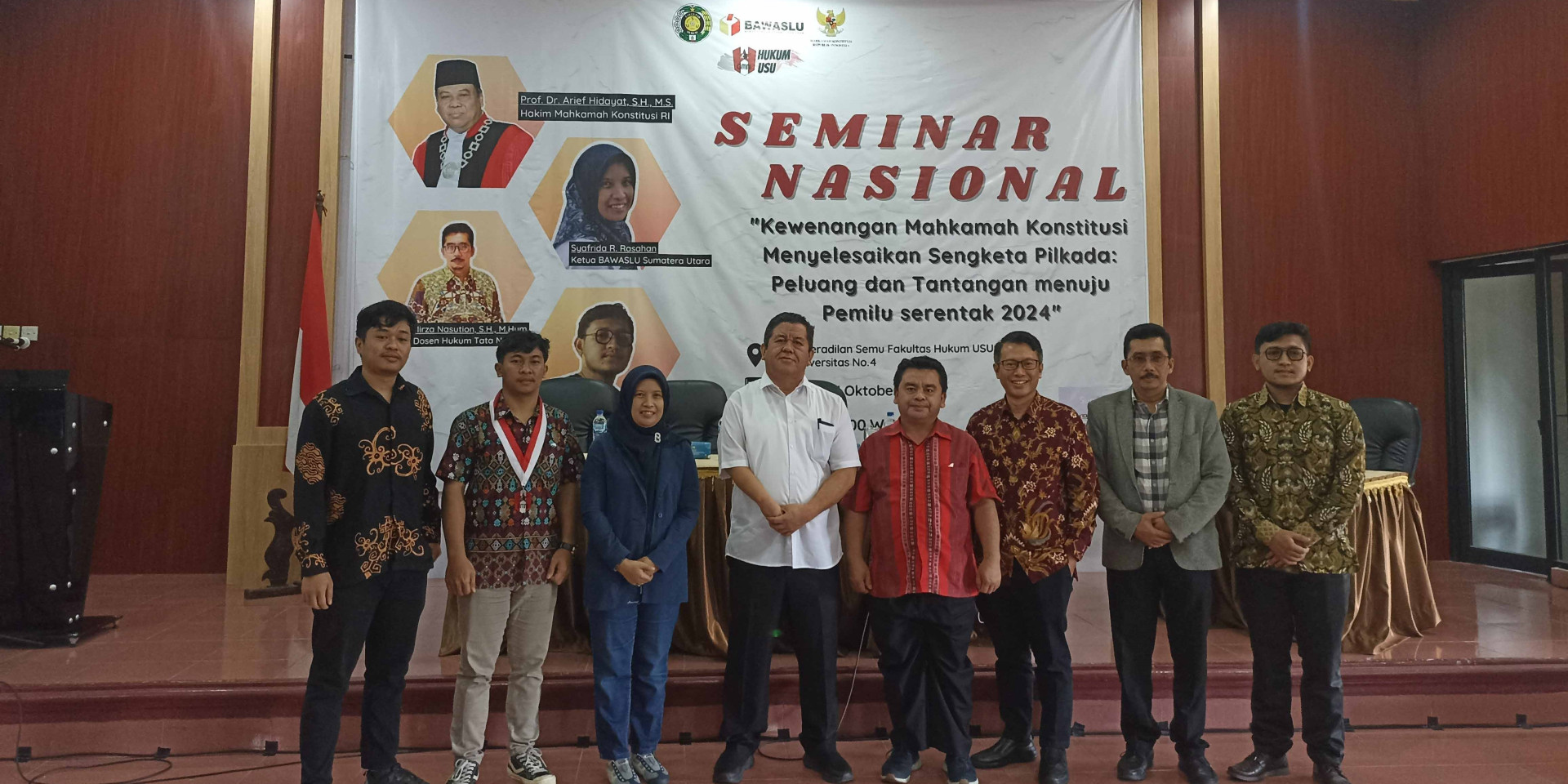
The Commissariat Management Board of the Indonesian National Student Movement, Faculty of Law, Universitas Sumatera Utara (DPK GMNI FH USU) held a National Seminar at the Moot Court Building, Faculty of Law, USU. This national seminar raised the title “The Authority of the Constitutional Court to Resolve Pilkada Disputes: Opportunities and Challenges Towards the 2024 Simultaneous Elections”.
This National Seminar raised the issue of the permanent authority of the Constitutional Court in resolving Pilkada disputes. Inviting three speakers, namely Dr. Irfan Nur Rachman, S.H., M.H. (expert assistant to the Constitutional Judge), Syafrida R. Rasahan, S.H. (Chairman of Bawaslu North Sumatra), Dr. Mirza Nasution, S.H., M.Hum. (Constitutional Law Expert / Lecturer in Constitutional Law FH USU), and moderated by Christian Hutahaean, S.H., as a cadre of GmnI FH USU. The seminar was also attended by the Dean of the Faculty of Law USU, Dr. Mahmul Siregar, SH, M.Hum, alumni of DPK GmnI FH USU, FH USU students, and various other elements of civil society.
The first speaker, Dr. Irfan Nur Rachman, S.H., M.H., discussed the return of the Court's constitutional authority: opportunities and challenges for simultaneous elections in 2024. He explained that there are two regimes in the regional election. The two regimes are Local Government and General Elections. The political-legal design of the Regional Election, which is quite long from 2004-2022, has dynamics and constitutional changes. Most recently, based on the Constitutional Court's decision No.85 / PUU-XX / 2022, there is no difference in the election regime, so the regional election is included in the election regime as in Article 22E of the 1945 Constitution.
He revealed six reasons for the Court to include the Regional Election in the election regime. The six principles of direct, general, free, secret, honest, and fair election implementation are the principles that apply to both the National Election and the Local Election. The laws governing the Election Organizing Institutions (KPU, Bawaslu, and DKPP) do not distinguish between the National Election and the Local Election; Election participants, both those carried by political parties and individuals, do not distinguish between the National Election and the Local Election; and in terms of resources and financing, the fusion of the two election regimes is more efficient than being held by two different organizers.
Nevertheless, he also described the many fraud trends in implementing regional elections. The practice of administrative violations, ethical violations of organizers, and money politics are still problems that must be addressed. He said that applying a work pattern with a spirit of cooperation is one strategy that can be used to resolve disputes and issues.
The second speaker, the chairman of Bawaslu North Sumatra, Mrs. Syafrida R. Rasahan, S.H., said that we must realize the implementation of a fair election. The success of election law enforcement will be achieved if the law's substance, structure,e and culture of law are well implemented and comprehensively regulated. If these three factors are well implemented, violations can be minimized. He also invited all elements present at this national seminar to disseminate knowledge to the community. This step was taken so that young people play an active role in realizing a fair election.
The third speaker, Dr. Mirza Nasution, S.H., M.Hum., explained the constitutionality of the election. Previously, this Constitutional Law Expert explained the role and function of the Constitutional Court. The Constitutional Court acts as a guardian of the constitution, interpreter of the constitution, and guardian of democracy. In carrying out its function as a guardian of democracy, the Constitutional Court upholds the principles and substantive justice (disputes handling elections and regional elections). He also invited young people who are agents of change to oversee the election.
The seminar lasted approximately 3 hours, from 09.00 to 12.00 WIB. At the end of the discussion, there were three questions from the participants. The debate also closed with the distribution of plaques to the three speakers. After that, a group photo was taken with the speakers, moderator, and all seminar participants. It is hoped that all participants who attend can spread knowledge and ideas to the community as the responsibility of intellectuals is pinned on students.