


.webp)
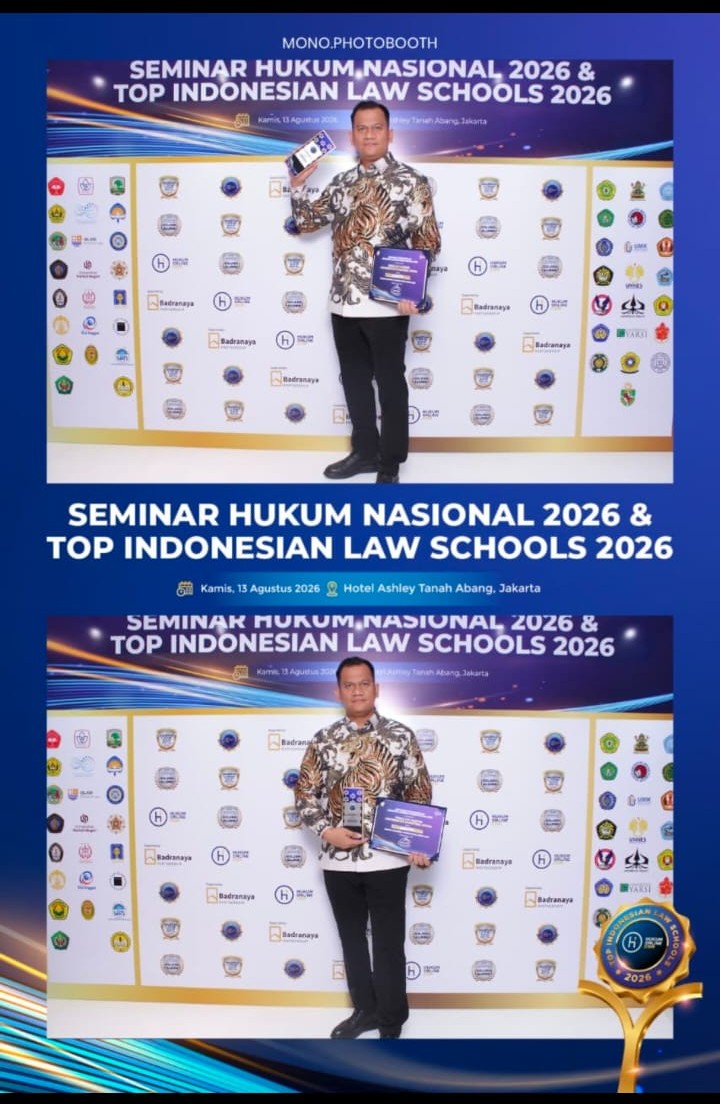
On Thursday (August 13, 2026), the Faculty of Law, Universitas Sumatera Utara (FH USU), participated in the 2026 National Law Seminar and Top Indonesian Law Schools 2026 organized by Hukumonline at the Ashley Tanah Abang Hotel, Jakarta.
The Dean of the Faculty of Law, Universitas Sumatera Utara, was represented by Dr. Tommy Aditia Sinulingga, S.H., M.H., who attended the national forum as a representative of FH USU. The event brought together various higher education institutions specializing in law, academics, practitioners, and stakeholders in the legal sector.
The event consisted of two main sessions. The first was the National Law Seminar, which discussed “Follow the Money: Asset Recovery Strategies as a New Paradigm in Criminal Law Enforcement.” The second session was part of Top Indonesian Law Schools 2026, during which FH USU received two recognitions.
The 2026 National Law Seminar focused on the theme “Follow the Money: Asset Recovery Strategies as a New Paradigm in Criminal Law Enforcement.” The speakers emphasized the importance of transforming the paradigm of criminal law enforcement from the conventional approach of “follow the suspect” toward an approach that also prioritizes “follow the money” and “follow the asset.”
This paradigm is based on the understanding that the success of law enforcement, particularly in economically motivated crimes, cannot be measured solely by the ability to identify, prosecute, and punish perpetrators. Law enforcement must also be capable of tracing financial flows, identifying and securing assets, recovering proceeds obtained through criminal acts through legal mechanisms, and optimizing asset recovery for the state or other parties legally entitled to receive them.
In one of the presentations, the Deputy Attorney General of the Republic of Indonesia emphasized that various forms of modern crime—including corruption, money laundering, narcotics offenses, human trafficking, online gambling, cybercrime, and organized crime—are fundamentally driven by the pursuit of economic gain.
Consequently, if perpetrators have been convicted while the proceeds of crime can still be enjoyed, concealed, transferred, or reinvested, the substantive objectives of law enforcement have not yet been fully achieved.
The follow the money paradigm is therefore not intended to replace follow the suspect, but rather to complement it. Law enforcement must continue to identify perpetrators and hold them accountable while also ensuring that the economic benefits obtained from criminal acts do not remain under the control of unauthorized parties.
Meanwhile, the Head of the Asset Recovery Agency of the Attorney General’s Office of the Republic of Indonesia, Dr. Patris Yusrian Jaya, outlined practical asset recovery strategies for safeguarding state finances, including institutional transformation, operational procedures, and developments in procedural law in carrying out the agency’s responsibilities.
Asset recovery was positioned as an integrated process within law enforcement, covering the tracing, securing, management, and return of assets to legally entitled parties.
The discussion also highlighted the urgency of strengthening asset forfeiture regulations in Indonesia. Several issues of concern included the gap between the magnitude of losses caused by criminal acts and the value of assets successfully recovered, challenges arising when perpetrators die or flee abroad, and the development of methods for concealing criminal proceeds through digital assets and modern financial instruments.
From an academic perspective, Assoc. Dr. Prof. Hasbullah, S.H., M.H., CIIQA., Dean of the Faculty of Law, Universitas Adhyaksa, discussed asset recovery from the perspective of the economics of crime. In the context of economically motivated crimes, the success of law enforcement should not be measured solely by the conviction rate, but should also consider the asset recovery rate, or the extent to which the state can recover the proceeds and benefits obtained from criminal acts.
Amid efforts to strengthen the asset recovery paradigm, the seminar also highlighted another fundamental aspect: the protection of civil rights and legal certainty for bona fide third parties.
The strengthening of state authority to trace and seize criminal proceeds must remain within the framework of the rule of law. The tracing, blocking, seizure, and forfeiture of assets must be carried out in accordance with the law, while observing due process of law, proportionality, objection mechanisms, judicial oversight, and protection of legally acquired property rights.
Responding to the discussion, Dr. Tommy Aditia Sinulingga, S.H., M.H., CTL, C.Med., who represented the Dean of FH USU, stated that the follow the money and follow the asset paradigms represent important developments in Indonesia’s criminal law policy, particularly in addressing increasingly complex economic crimes.
“The follow the money and follow the asset paradigms are a necessity in addressing modern economic crimes. Law enforcement must not stop once perpetrators have been convicted while the proceeds of crime can still be enjoyed. However, effective asset recovery must continue to go hand in hand with the principles of the rule of law,” said Tommy.
He emphasized that an asset recovery-oriented approach must be balanced with the protection of legitimate rights.
“The effort to recover criminal proceeds must not disregard due process of law, legal certainty, proportionality, or the civil rights of bona fide third parties. Instruments designed to deliver justice must not instead create new injustices against individuals who can legally demonstrate that their assets were obtained lawfully,” he stressed.
Tommy noted that balancing effective law enforcement with the protection of rights is one of the fundamental aspects that must be considered in the formulation and implementation of asset recovery policies in Indonesia.
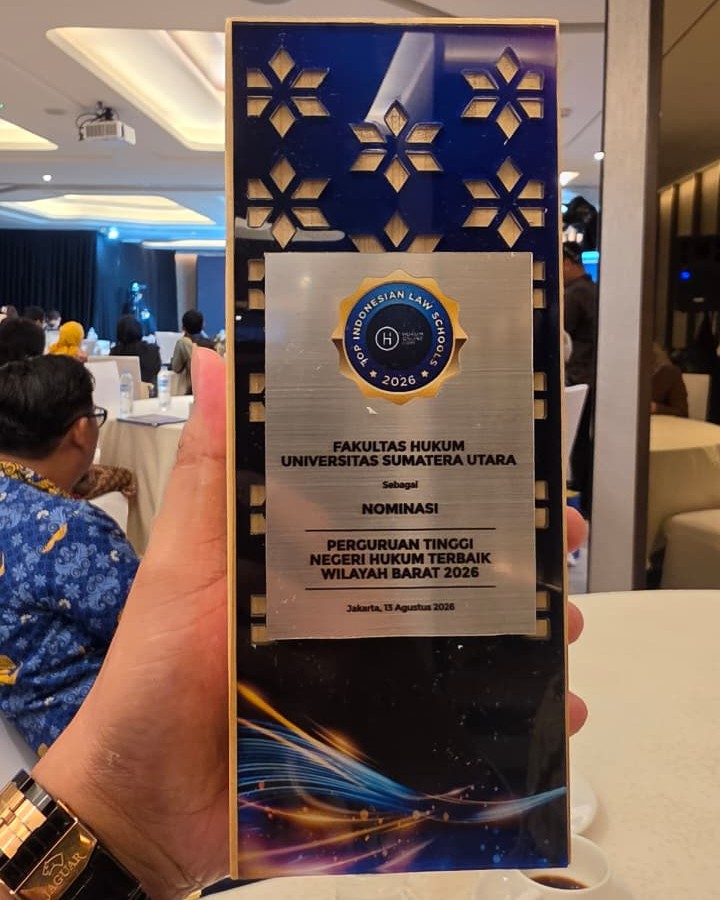
The second session continued with Top Indonesian Law Schools 2026. During this session, the Faculty of Law, Universitas Sumatera Utara, received two recognitions.
First, FH USU received a nomination for Best Law Higher Education Institution in the Western Region 2026 as part of Top Indonesian Law Schools 2026. Second, FH USU received the 2026 Digital Legal Literacy Award Certificate as the “2026 Campus Initiative for Advancing Digital Legal Literacy.” Both recognitions were received by Dr. Tommy Aditia Sinulingga, S.H., M.H., CTL, C.Med., representing the Dean of the Faculty of Law, Universitas Sumatera Utara.
Tommy stated that these recognitions were institutional achievements to be appreciated while also serving as a responsibility for the entire FH USU academic community to continuously improve the quality of legal education.
“On behalf of Dean Dr. Mahmul Siregar, S.H., M.Hum., and the entire academic community of the Faculty of Law, Universitas Sumatera Utara, we express our appreciation and gratitude to Hukumonline for the nomination and recognition given to FH USU. For us, this recognition is not merely an achievement, but also a mandate and motivation to continuously improve the quality of education, research, community service, and legal literacy,” said Tommy.
According to him, technological developments have significantly transformed how society obtains, understands, and uses legal information. Therefore, law schools must not remain outside the current of digital transformation.
“Digital legal literacy is becoming increasingly important. Law faculties must play a role in ensuring that technological developments instead expand public access to legal knowledge that is accurate, credible, and accountable,” he said.
Tommy added that legal education amid digital transformation must not lose its fundamental objective of developing legal professionals with integrity.
“Law faculties are not merely expected to produce graduates who understand legal norms and regulations. We must develop legal professionals who can think critically, adapt to technological developments, act professionally and with integrity, and have the courage to uphold the law and justice,” he stressed.
For FH USU, participation in the national forum carried two strategic meanings. In addition to providing an opportunity to follow developments in contemporary legal thought, the event also opened opportunities to strengthen institutional communication and networks with various law faculties, academics, practitioners, and law enforcement institutions.
FH USU is committed to continuously improving the quality of the university’s three pillars of higher education, strengthening digital transformation in legal education, and expanding academic and professional collaboration to enhance the faculty’s contribution to national legal development.
“We dedicate the recognition received today to the entire FH USU family and academic community. Institutional achievements are never the result of one person’s work, but rather the collective efforts of all elements of the faculty, including lecturers, educational staff, and students of FH USU,” said Tommy.
He expressed hope that the recognitions would not remain merely symbols of achievement, but would become a source of energy for FH USU to continue making improvements and pursuing innovation.
“We want FH USU to continue moving forward, recognized not only for its history and reputation but also for its tangible contributions to society, education, and the development of Indonesian law. We hope this recognition will become a source of energy for us to make the Faculty of Law, Universitas Sumatera Utara, increasingly excellent and competitive at both the national and international levels,” he concluded.
FH USU’s participation in the 2026 National Law Seminar and Top Indonesian Law Schools 2026 further demonstrates the institution’s commitment to actively contributing to the development of national legal education and thought, while building a legal education system that adapts to changing times without compromising the values of integrity, legal certainty, and justice.