


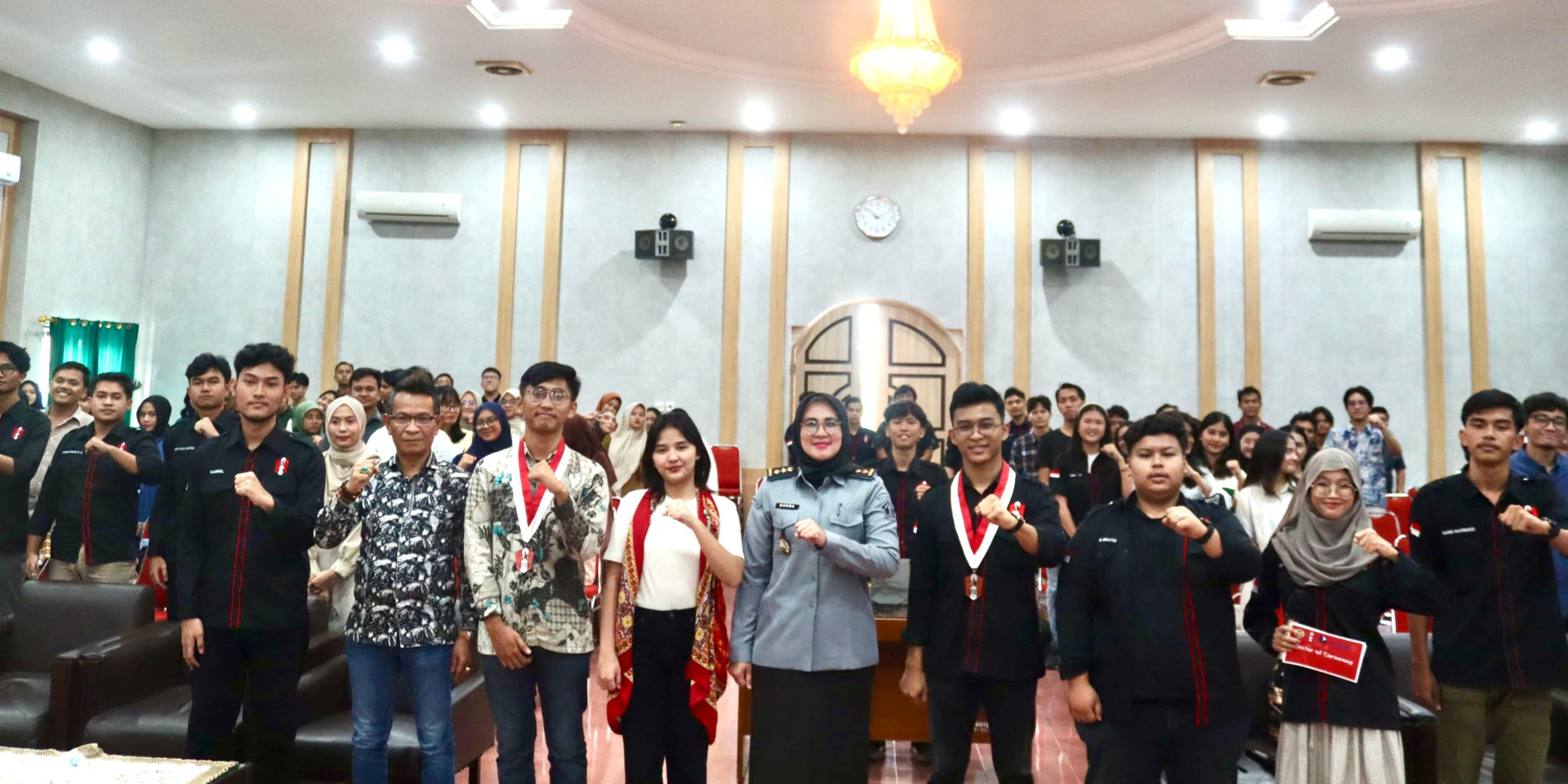
FH-USU PR: Tuesday (18/02/2024), the Executive Board of the Indonesian National Student Movement (DPK GmnI) of the Faculty of Law of Universitas Sumatera Utara (FH USU), in collaboration with the Indonesian Legal Aid Association (PBHI) and the Community Legal Aid Institute (LBHM), held a public dialogue titled "Exploring the Format and Assessing the Readiness of Death Penalty Commutation from a Human Rights Perspective." This event was conducted in a hybrid format, utilizing the Zoom platform and at the FH USU Moot Court Hall.
The seminar began with opening remarks from Dr. Robert, S.H., M.Hum., Expert Staff to the Dean for Student Affairs and Alumni of FH USU. In his speech, Dr. Robert stated that the concept of the death penalty requires a comprehensive study. He also noted that the new Criminal Code (KUHP) has been enacted and has sparked much debate, leaving the focus now on its implementation mechanism, which must be approached with caution. He further emphasized that this discourse is an interesting topic to discuss.
Gina Sabrina from PBHI stated that Medan, North Sumatra, is one of the most important regions for observing how preparations shape public opinion on this issue. She hoped that an appropriate format could be found to address the matter while also considering the human rights perspective and the shifting paradigm of Indonesia's criminal justice system. She emphasized the need for this to result in a well-formulated regulation.
Gray Anugrah Sembiring, the Commissioner of DPK GmnI FH USU, stated that the death penalty and its practice in Indonesia are highly complex and problematic within the country's legal system, both philosophically and textually, highlighting the need for thorough preparation. He thanked everyone for attending and participating in this highly engaging discussion.
The seminar featured four experienced speakers: Annisa Azzahra from PBHI, who discussed the commutation of the death penalty in the Criminal Code (KUHP) from a human rights and humanitarian perspective; Majda El Muhtad from the Center for Human Rights Studies (Pusham) at UNIMED, who spoke about the implementation of death penalty commutation from a human rights perspective; Nurma Yulianti, S.Pd, M.H, from Medan Class 1 Penitentiary, who addressed the potential application of death penalty commutation under the new Criminal Code and the operational challenges in its implementation; and Dr. Mahmud Mulyadi, S.H., M.Hum, an academic from FH USU, who provided a legal analysis of Article 101 of the new Criminal Code to formulate policy recommendations for drafting an appropriate Government Regulation (RPP). Dozens of students from various organizations within the Faculty of Law and civil society organizations also participated enthusiastically in the event.
This public dialogue is expected to provide new insights into regulating death penalty commutation in the new Criminal Code (KUHP), enabling the public to develop a more comprehensive understanding of its implementation in Indonesia. Additionally, it aims to offer potential solutions for the procedural enforcement of the death penalty within the country's criminal justice system.