


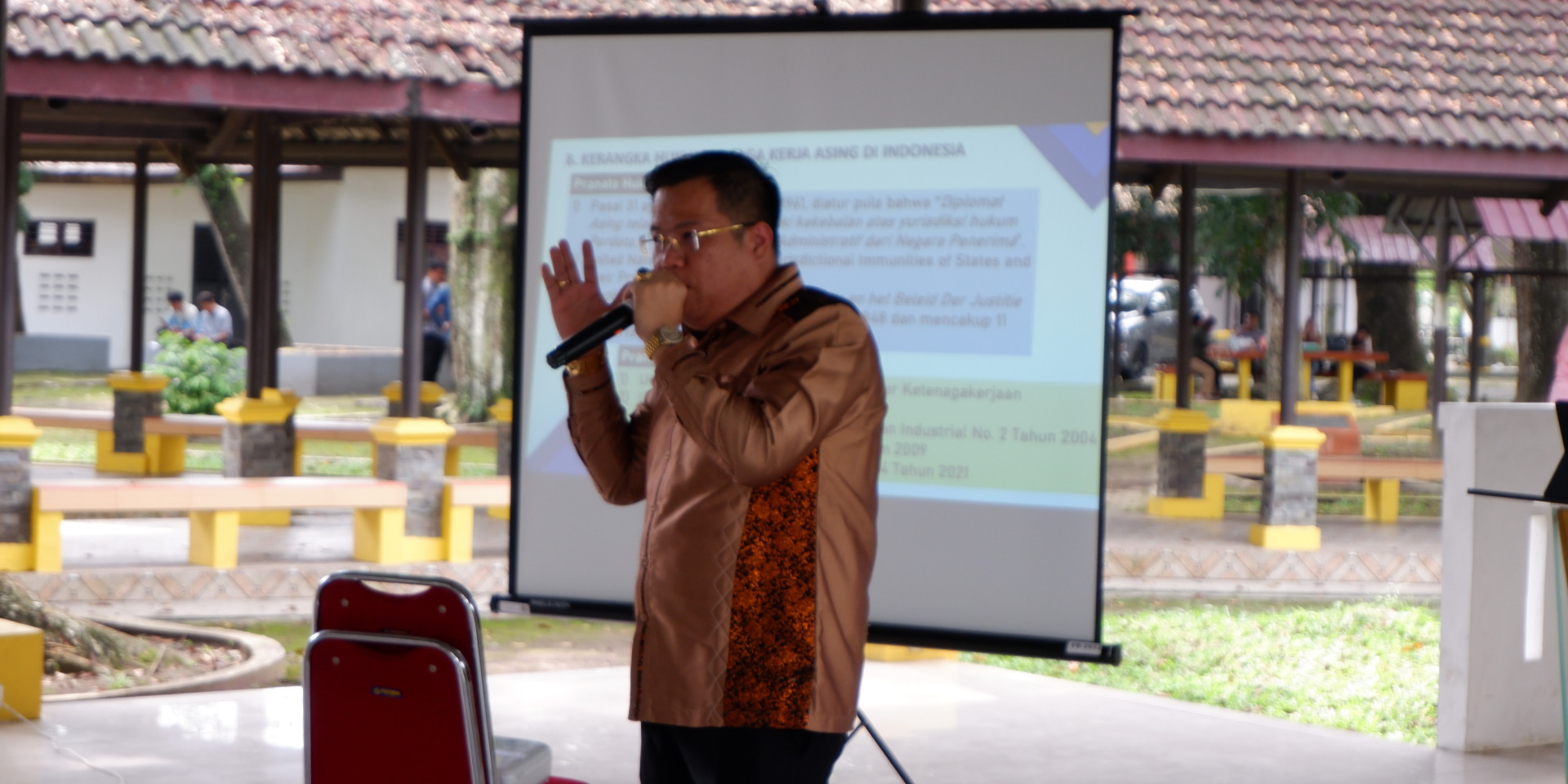
FH-USU PR: Tuesday (18/02/2025), The Faculty of Law of Universitas Sumatera Utara (FH USU), in celebration of its 71st Anniversary, held the second session of the Alumni Teaching Program, featuring Dr. Darmawan Yusuf, S.E., S.H., M.Pd., M.H., CTLA., Mediator as the speaker. He is an alumnus of FH USU, an advocate, and the owner of Darmawan Yusuf & Associates Law Firm. This second session took place at the Pendopo of FH USU and was attended by FH USU students from various specializations. The event began with an opening speech by Erni Ariyanti Sitorus, S.H., M.Kn, the Head of the FH USU 71st Anniversary Committee, represented by Dr. Yati Sharfina Desiandri, S.H., M.H. The session was moderated by Siti Nurahmi Nasution, S.H., M.H., a lecturer at FH USU.
The theme of this second session of the Alumni Teaching Program was "Settlement of Foreign Worker Disputes in Indonesia," which is the dissertation research of Dr. Darmawan Yusuf. The presentation focused on foreign workers employed at foreign embassies in Indonesia who experience disputes with their respective embassies. The key points discussed were related to international legal frameworks, including the 1951 Vienna Convention, which regulates the diplomatic immunity of foreign diplomats from civil, criminal, and administrative jurisdiction in the host country, the 2004 United Nations Convention on Jurisdictional Immunities of States and Their Property, as well as the Reglement op de Rechterlijke Organisatie en het Beleid Der Justitie in Indonesia.
The relevant national legal frameworks include UU Number 6 of 2023 on Job Creation (Employment Cluster), UU Number 13 of 2003 on Manpower, UU Number 2 of 2004 on Industrial Relations Dispute Settlement, UU Number 48 of 2009 on Judicial Authority, and Government Regulation Number 34 of 2021 on the Employment of Foreign Workers in Indonesia.
Dr. Darmawan Yusuf explained the implementation of these legal institutions by highlighting the challenges and obstacles in resolving disputes involving foreign workers employed at foreign embassies in Indonesia. These challenges generally relate to diplomatic immunity, the extraterritorial principle of foreign embassies, and the unenforceability of Indonesian court rulings on disputes involving foreign workers at embassies, even when the workers win in court.
Dr. Darmawan Yusuf further explained that diplomats involved in foreign worker disputes generally invoke their immunity rights as stipulated in the 1951 Vienna Convention. However, this immunity fundamentally applies only to their roles and functions as diplomats carrying out missions in the host country. Similar cases brought before Indonesian national courts often result in rulings favoring the foreign workers, but the main obstacle remains the inability to enforce these rulings. This is due to Indonesia not yet ratifying the United Nations Convention on Jurisdictional Immunities of States and Their Property 2004 into its national law.
During the question-and-discussion session, one of the students asked why the Indonesian government has been reluctant to ratify the United Nations Convention on Jurisdictional Immunities of States and Their Property 2004 into its national law. In response, Dr. Darmawan Yusuf explained that this hesitation is related to Indonesia's relatively weak position when facing lawsuits in foreign courts. There is still uncertainty about ratifying the convention, as doing so would mean that the rights and obligations concerning state immunity would not only apply when a sending state is sued in Indonesian national courts but also when Indonesia, as a sending state, is sued in foreign courts of the host country where the Indonesian embassy is located.
The second session of the Alumni Teaching program concluded with the presentation of a plaque and certificate to the speaker, followed by a group photo.