


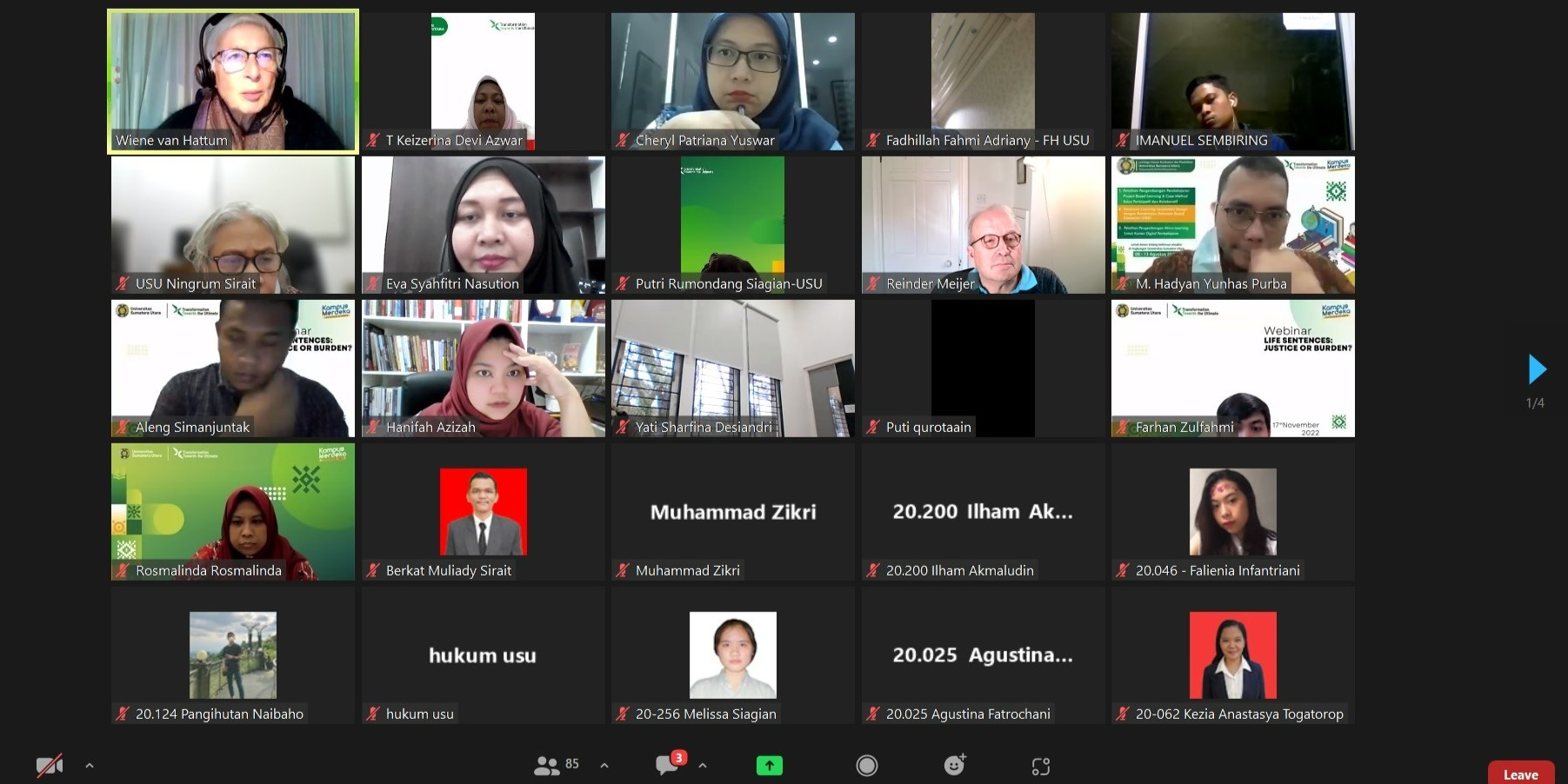
Public Relations FH-USU: Thursday (17/11/2022) The USU Doctor of Law Studies Program held a webinar titled "Life Sentences: Justice Or Burden?" This webinar activity was opened directly by Dr. Mahmul Siregar, S.H., M.Hum (Dean of the Faculty of Law USU) and Prof. Dr. Ningrum N. Sirait, S.H., M.Li (Chairperson of the FH USU Doctor of Law Studies Program) gave a speech at this webinar activity, This webinar activity was guided by Cheryl Patriana Yuswar, S.H., LL.M (Lecturer FH USU) as Moderator.
The material presentation was presented directly by Mr. dr. Wiene F. van Hattum (President of “Forum Life Levenslang” Assistant Professor of Criminal Law) and Eva Syahfitri Nasution, S.H., M.H. (Lecturer FH USU). In Indonesia, a life sentence is one of the two forms of imprisonment regulated by the Criminal Code. Philosophically, a person who is sentenced to life imprisonment is a person who violates the law and certainly feels suffering (punishment). Life imprisonment, like the death penalty, is a type of absolute punishment. Life imprisonment means the punishment is executed until the end of the convict's life. Life imprisonment is a form of bare punishment that can be imposed by the judge, which means that it can be imposed alone or in combination with additional punishment. As part of the deprivation of liberty punishment, life imprisonment contains many paradoxical aspects, which legal experts often debate. The retention of life imprisonment does not mean that life imprisonment in the Indonesian punishment system has been unconditionally accepted by society.
This activity was closed by Dr. T. Keizerina Devi Azwar, S.H., CN., M.Hum (Secretary of the Doctor of Law Science FH USU), who appreciated the two presenters and filled this activity with each speaker's abilities and knowledge. This webinar activity is expected to contribute to establishing deeper cooperation in scientific matters.