



HUMAS FH-USU: On Wednesday, August 26, 2026, the Master’s Program in Law Studies (MIH) at the Faculty of Law, Universitas Sumatera Utara (FH USU), held a scholarly writing training program focused on enhancing academic quality and strengthening the originality of students’ academic work. The activity was designed to equip students with the knowledge and skills needed to produce high-quality, academically rigorous, and highly original theses and scholarly journal articles.
The activity was also part of the Master’s Program in Law Studies’ commitment to supporting the achievement of the Sustainable Development Goals (SDGs), particularly SDG 4: Quality Education through strengthening students’ academic competencies; SDG 9: Industry, Innovation and Infrastructure through developing research capacity and innovative academic ideas; SDG 16: Peace, Justice and Strong Institutions through promoting academic integrity, ethics, and responsibility, particularly in the development of legal scholarship; and SDG 17: Partnerships for the Goals through collaboration among the study program, academics, alumni, and students in building a high-quality academic ecosystem.
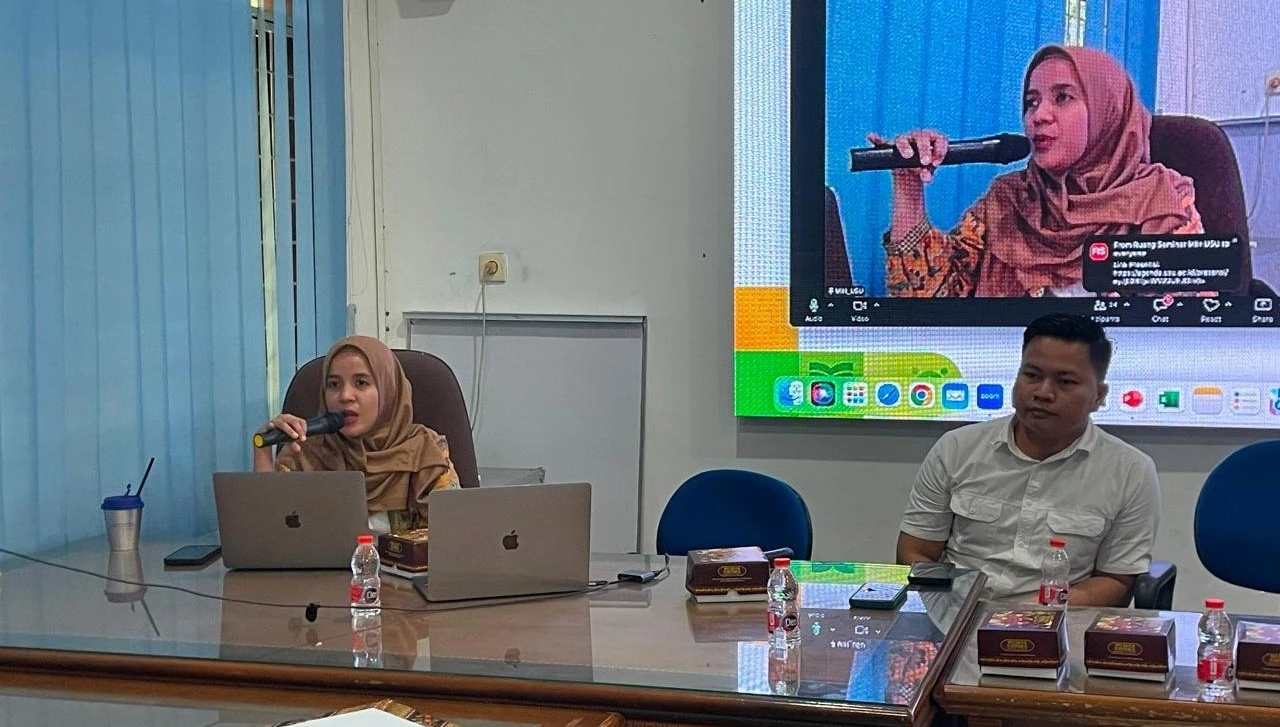
The hybrid activity, conducted both online and onsite, was enthusiastically attended by students of the Master’s Program in Law Studies. A total of 50 participants joined online, while 11 participants attended in person.
The activity was attended by the Head of the Master’s Program in Law Studies, Dr. Mahmud Mulyadi, S.H., M.Hum., and the Secretary of the Master’s Program in Law Studies, Dr. Rosmalinda, S.H., LL.M. The session was moderated by Liza Hafidzah Yusuf Rangkuti, S.H., M.H., an alumna of the Master’s Program in Law Studies at USU.
In his remarks and opening of the activity, Dr. Mahmud Mulyadi, S.H., M.Hum., emphasized the importance of scholarly writing training for students of the Master’s Program in Law Studies. According to him, the ability to produce scholarly work is essential to students’ academic success, particularly as theses and scholarly publications constitute academic outputs required at the master’s level.
“This activity is important to attend because the materials presented are highly beneficial in helping students become more proficient in preparing theses and scholarly journals as part of the mandatory academic outputs,” said Dr. Mahmud.
He expressed hope that the activity would not only improve students’ technical writing skills but also raise awareness of the importance of academic integrity in every scholarly work they produce. This effort is aligned with the spirit of SDG 4: Quality Education, which places improvements in educational quality and access to quality education among the foundations of sustainable development.
The training featured two speakers with experience in academia and scholarly writing. The first speaker, Dr. Syarifah Lisa Andriati, S.H., M.Hum., delivered material on important aspects of scholarly writing, particularly academic ethics, integrity, and the author’s responsibility to produce work that can be academically and scientifically accounted for.
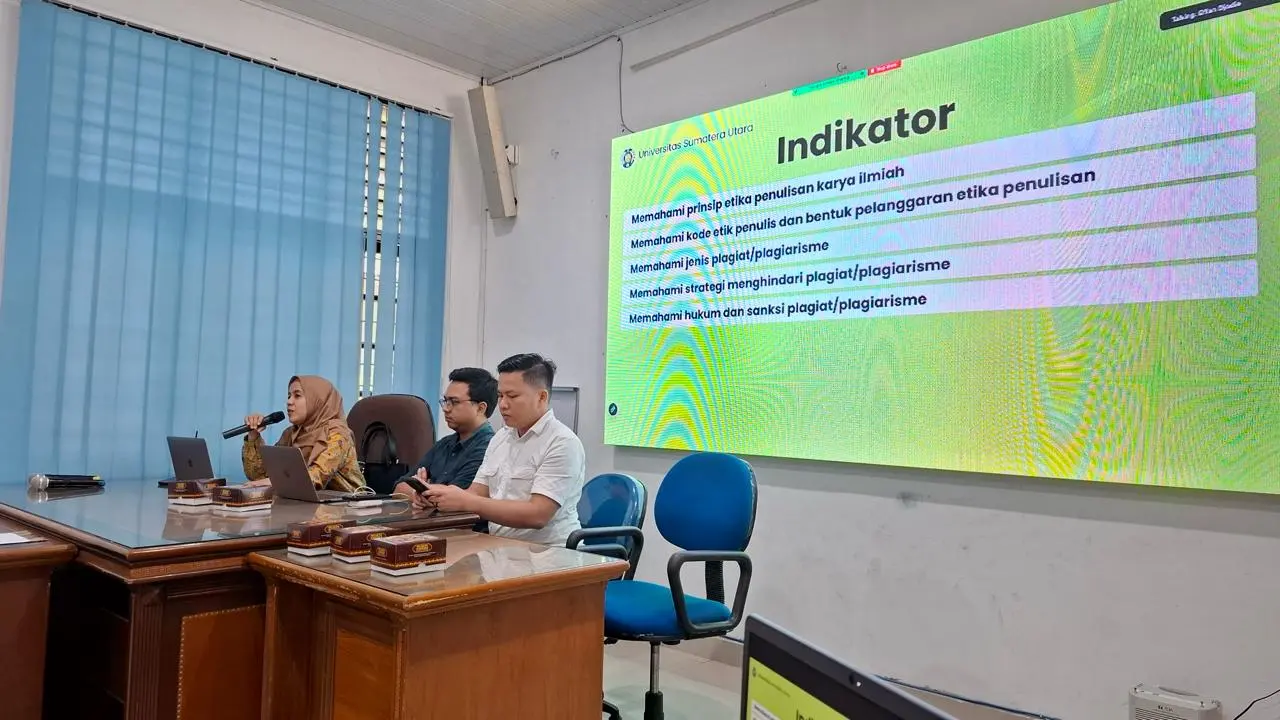
In her presentation, she emphasized that ethical conduct and morality are fundamental foundations of scholarly writing, whether for theses or journal articles. Authors are not only expected to develop academic arguments and conduct sound analysis but must also uphold honesty, integrity, and ethical standards when using sources and developing ideas.
Plagiarism, for example, is not merely a technical issue in writing but can constitute a serious problem that affects the credibility of both students and educational institutions. Therefore, students need to understand that every scholarly work should emerge from an honest and responsible academic process that respects the intellectual contributions of others.
Strengthening integrity and responsibility is also relevant to SDG 16: Peace, Justice and Strong Institutions, particularly in fostering an academic and institutional culture that is transparent, accountable, ethical, and grounded in principles of justice. In legal education, developing academic character based on integrity is also essential in preparing human resources capable of contributing to stronger legal systems and credible institutions.
Meanwhile, the second speaker, Fahrizal S. Siagian, S.H., M.H., an alumnus of the Master’s Program in Law Studies at USU, recipient of funding from the Directorate of Research, Technology, and Community Service (DRTPM) of the Ministry of Education, Culture, Research, and Technology in 2024, and a doctoral student in Legal Studies at USU, emphasized the importance of originality as an indicator of scholarly quality.
According to Fahrizal, originality should not be understood merely as the absence of plagiarism but also as students’ ability to develop ideas, conduct analysis, formulate arguments, and contribute academic perspectives of value.
“Originality is an important part of building academic quality. Students must not only be able to collect and cite various sources but also be able to process those sources into arguments and ideas that make a scholarly contribution,” Fahrizal explained.
The ability to produce original ideas and research also supports the spirit of SDG 9: Industry, Innovation and Infrastructure, particularly by promoting innovation through strengthened research capacity and the development of knowledge. High-quality scholarly work is expected not merely to fulfill academic requirements but also to generate legal perspectives that respond to societal developments and contribute to the advancement of legal scholarship and the resolution of various legal issues.
He also noted that the quality of scholarly work ultimately reflects the quality of the educational process within a higher education institution. Therefore, students of the Master’s Program in Law Studies at USU are expected to produce work that not only meets academic requirements but also demonstrates intellectual maturity, integrity, and responsibility as members of the academic community.
The training was conducted interactively, with participants actively engaging through questions and responses during the discussion sessions. Participants used the opportunity to deepen their understanding of writing techniques, originality, academic ethics, and various challenges encountered in preparing theses and journal articles.
The involvement of the study program’s leadership, academics, alumni, master’s students, and doctoral students also reflected the spirit of SDG 17: Partnerships for the Goals, namely building partnerships and collaboration to support sustainable development objectives. Such collaboration across different roles within the academic community is expected to strengthen the exchange of knowledge, experience, and good practices in the development of legal education and research.
The activity was part of the Master’s Program in Law Studies’ ongoing efforts to enhance students’ academic capacity and quality. Strengthening scholarly writing skills is considered essential in preparing students to meet academic demands while encouraging the production of high-quality scholarly works that contribute to the development of legal knowledge.
Through the training, the Master’s Program in Law Studies at USU hopes that students will develop a stronger understanding of the importance of integrity, ethics, originality, and sound argumentation in every scholarly work they produce.
The activity was successfully conducted and received positive responses from participants. Through similar activities held on an ongoing basis, the Master’s Program in Law Studies at the Faculty of Law, Universitas Sumatera Utara, expects to further strengthen an academic culture that upholds integrity and originality. Strengthening quality education, research and innovation, institutional integrity, and collaboration across the academic community represents the program’s tangible contribution to the achievement of SDG 4, SDG 9, SDG 16, and SDG 17.