The Doctoral Program in Law Studies of Universitas Sumatera Utara (USU) is the highest level of legal education for higher education. The program focuses on teaching legal science, including legal philosophy, legal theory construction, research, and legal writing, aiming to train academics who can convey legal theories and doctrines to the public through various media.
Graduates of the USU Doctoral Program in Law Studies have a significant opportunity to become competent legal experts, researchers, and state legal officials who will play a crucial role in advancing the legal field in Indonesia. The Doctor (Dr.) degree obtained by students who complete this study program is proof of their dedication and ability to develop legal studies and make a positive contribution to society and the country.


History
Vision & Mission
To Become a Doctoral Program in Law Studies That Is Excellent, Has Integrity, is Competitive, and Is Able to Apply the Development of Science and Technology in Legal Development, Both National and International.
- To educate scholar cadres of qualified Doctor of Law Studies with a scientific base and responsibility that has national and global competitiveness.
- To educate scholar cadres of Doctor of Law Studies who have integrity and personality and are able to participate in the process of developing science and technology, as well as socio-cultural developments for the benefit of the nation and state by upholding religious values and morality.
- To educate scholar cadres of Doctor of Law Studies with liberation and enlightenment of thinking based on legal reasoning to produce new findings that are beneficial for the application of legal development in Indonesia.
Goals & Targets
- To produce Doctor of Law scientists who have a scientific basis and responsibility at the national and global levels.
- To produce Doctor of Law scientists who have integrity and personality and can see the problems of law and society in an integrally comprehensive manner with freedom and enlightenment of thinking that does not conflict with religion and morals.
- To produce competent academic lecturers and researchers in their fields who can apply and develop legal science to find something new with the latest national and global community needs.
- To produce human resources who can develop their professional performances in a broader spectrum by their respective professions.
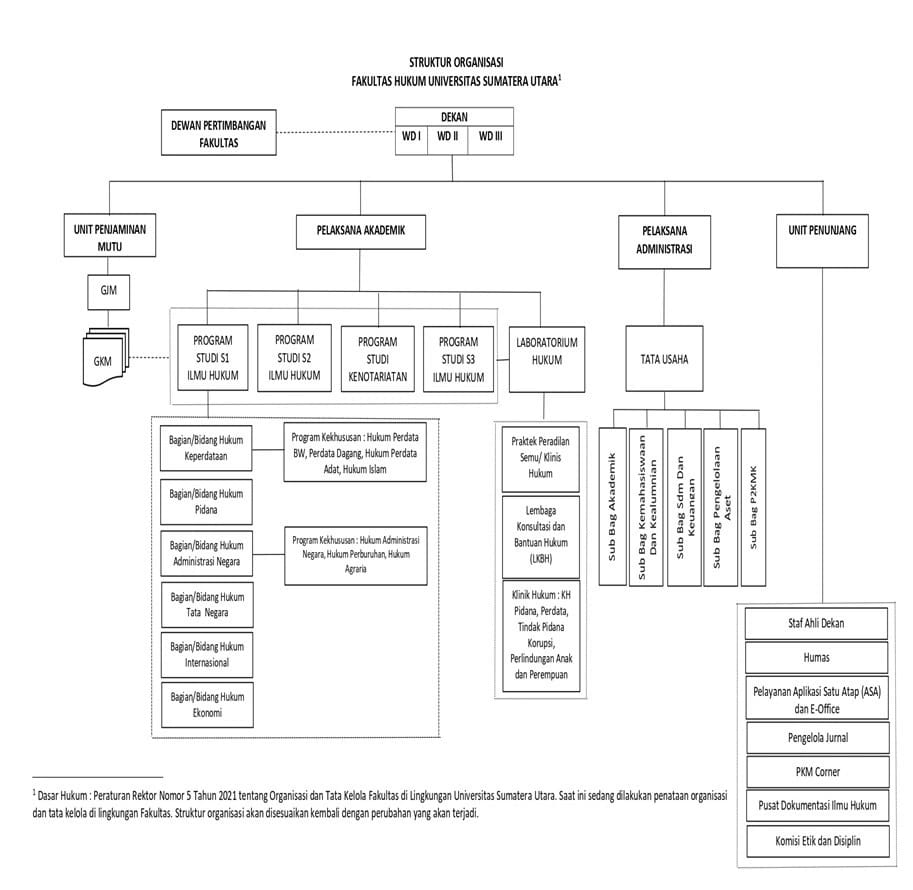
Organization Structure