


PR - FH USU (14/08/2022) In Indonesia, the employment relationship discussed by the Labour Law was initially known as one type of employment relationship, namely, a “standard employment relationship.” Article 1 number 15 of Law Number 13 of 2003 concerning Manpower (Labour Law) defines the employment relationship as follows: “the relationship between employers and workers/laborers based on an employment agreement, which has elements of work, wages, and orders.” This standard labor relationship has finally undergone developments and changes in various countries' situations. Over time, what is referred to as “Non-Standard Employment Relations” has emerged, where the circulating definitions continue to differ in various countries. The International Labour Organization (ILO) defines non-standard employment as a type of employment relationship that is a deviation from the standards set for employment relations in general.
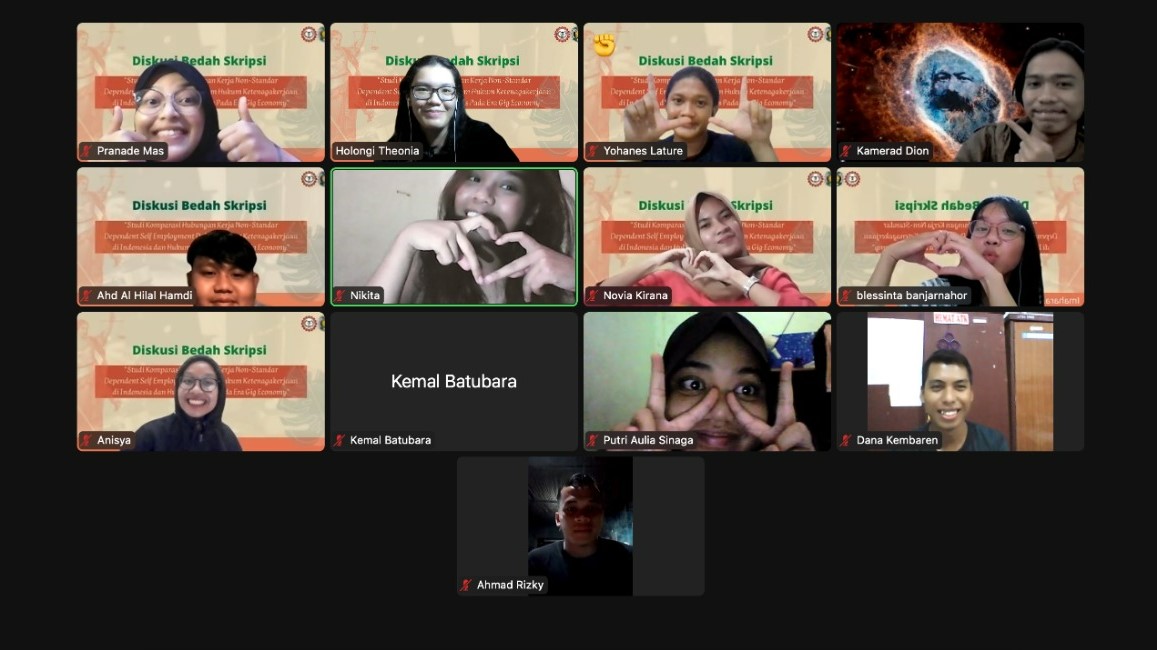
These terms are massively manifested in the era of the Indonesian gig economy in the form of ‘hubungan kemitraan’, or partnerships. For example, in online transportation modes, expeditions, and some creative ssectors The State Administrative Law Student Association of the Faculty of Law, University of Sumatera Utara held a thesis dissemination by an alumnus of the USU law faculty, Pranade Mas SH., on Sunday, August 14, 2022, which was held online from 20.00 WIB. Pranade’s thesis is entitled “Comparative Study of Non-Standard Dependent Self Employment Relations in Indonesian and English Labour Law in the Gig-Economy Era”. It was explained that this discussion was carried out as the first step in the beginning of the need to be sensitive to social issues about employment, which today are always in the lives of many people.
Focusing on Non-Standard Dependent Self Employment, the background of writing this thesis was also presented by Pranade using the reason that the influence of the industrial revolution triggered a change in mindset, work pattern, and lifestyle so that these changes gave rise to the term Gig Economy. It is explained that this employment relationship is a covert employment relationship in which an employer disguises his worker status with the aim of negating or weakening the protections afforded by law to workers. In this country, Dependent Self-employment manifests in a so-called ‘hubungan kemitraan’ or partnership.
This work practices exist in several companies, but there are two big companies that were brought up in this thesis, namely Gojek and Grab. Another interesting fact brought up is that on February 19, 2021, the UK Supreme Court through a court decision stated that Uber drivers in the UK have the status of workers, in contrast to online motorcycle taxi drivers in Indonesia, who in fact are drivers from Gojek and Grab, are only defined as workers and employers who are united in a system wrapped in the word partnership without being able to have control over the work they carry. For example, in terms of choosing passengers, setting fares, setting sanctions, as well as ratings that drivers receive from passengers, it is set unilaterally by the system created by the company. It aspires to reform the labour laws but is still facing the same obstacle. As an example, the intermediary of technology and the lack of legal instruments that address the meaning of the element of the order makes the relationship between workers and employers an opaque relationship with shelter behind the word "flexibility," when in fact it is the only language that is refined as "slavery," so that the partnership in question is not required to provide social security for its workers. Also, the absence of political will Where the government is less sensitive to things that are urgent to be set normatively as a regulation, for example, that the Manpower Law must regulate non-standard independent self-employment relations, so that online motorcycle taxi drivers are protected by law.
Imahara's hope from this thesis dissemination, delivered by Dion Pardede as the Chair, is that the students must see comprehensively growing public issues. Students are also expected to continue to criticize regulations that are often not pro-people, especially workers. "As students, we should not be naïve; of course, criticism of regulations is necessary, but don't expect much as long as we have a not so pro-people government and representative. There must be a more radical and creative way to suppress change. Take it this way; perhaps, the best way to fix the law is to make people no longer trust the law. Good People Disobey Bad Laws." Dion said