


 ok.webp)
Public Relations FH-USU: Jakarta, Monday (07/08/2023)
Professor of Customary Law at the Faculty of Law, Universitas Sumatera Utara (FH USU), Prof. Dr. Rosnidar Sembiring, S.H., M.Hum appeared as a resource person at the International Conference held by the MPR RI together with the Indonesian Customary Law Teachers Association (APHA). The three-day International Conference (6 - 8 August 2023) at Nusantara IV Building of MPR RI, Central Jakarta, was opened by Dr. St. Laksanto Utomo, S.H.MH as Chairman of APHA, and also attended by Dr. H. Bambang Soesatyo, S.E., S.H., MBA (Chairman of MPR RI / Permanent Lecturer of Doctor of Law at Borobudur University), H. Ahmad Sahroni, S.E., M.I.Kom (Vice Chairman of Commission III DPR RI), and Prof. Dr. Moh. Mahfud, M.D., S.H., S.U., M.I.P (Coordinating Minister for Politics, Law and Security RI), who acted as Keynote Speaker at this international conference.
This conference is motivated by the existence of Indigenous peoples in various parts of the world, and all the dynamics and challenges continue to encourage the international community to create various frameworks and norms to strengthen the protection and recognition of Indigenous peoples. Since 2002, the Indigenous Peoples Bill, which was later changed to the Indigenous Peoples Bill, has been proposed and included in the Legislation Body (BALEG) since 2020. Still, until now, it has always been an obstacle. The main obstacle is the political tug-of-war over the Indigenous Peoples Bill in both the executive and legislative branches.
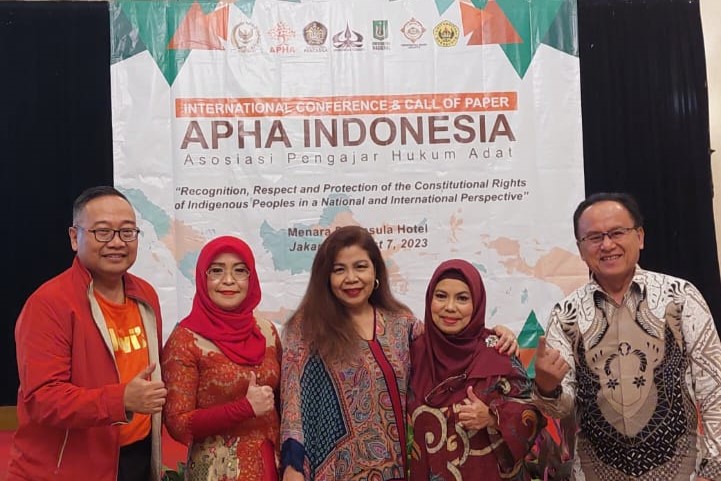
In response, the Customary Law Teachers Association (APHA) needs to discuss the direction and existence of Indigenous peoples and the implementation of customary law in various aspects, including the development of customary law economic law. This conference consists of five (5) sub-themes of Panel Sessions and Call for Papers, namely, (1). The Responsibility of the State and Companies towards MHA around Mining and Natural Resources; (2). State, Company, and Community Responsibilities towards the Rights of Indigenous Women and Children; (3). Customary Justice with Justice; (4). International Politics and the Fulfillment of the Rights of Indigenous People; (5). The Role of the State in the Development of Customary Economic Law for the Welfare of Indigenous People.
Furthermore, the activity session moved to the Peninsula Hotel Tower, West Jakarta, continuing the Panel Session. One of the speakers in panel 5 in this activity was delivered by a Professor of Customary Law at the Faculty of Law, University of North Sumatra, Prof. Dr. Rosnidar Sembiring, S.H., M.Hum who presented material on “Indonesia Towards the Concept of a Welfare State Reflecting on its Customary Economic System and Law.” In her presentation, Prof. Dr. Rosnidar Sembiring, S.H., M.Hum said that Indonesia, in heading towards a welfare state, must be able to create social security in all fields, including in the field of protection of indigenous peoples, as well as develop customary economic systems in various regions to realize the state's goals as stated from the beginning in the Preamble of the 1945 Constitution. Local communities, especially customary law communities, can also be empowered by the state to maximize all the potential of local wisdom that exists and is spread throughout the regions in Indonesia. The state, through local governments, can also create an adaptive economic system and law based on the territorial conditions of the area. The state also needs to take a role in accommodating and socializing case settlements integrated with the judiciary and customary law system because, in the process of development and the running of the economy, it will certainly not rule out the possibility of disputes.