


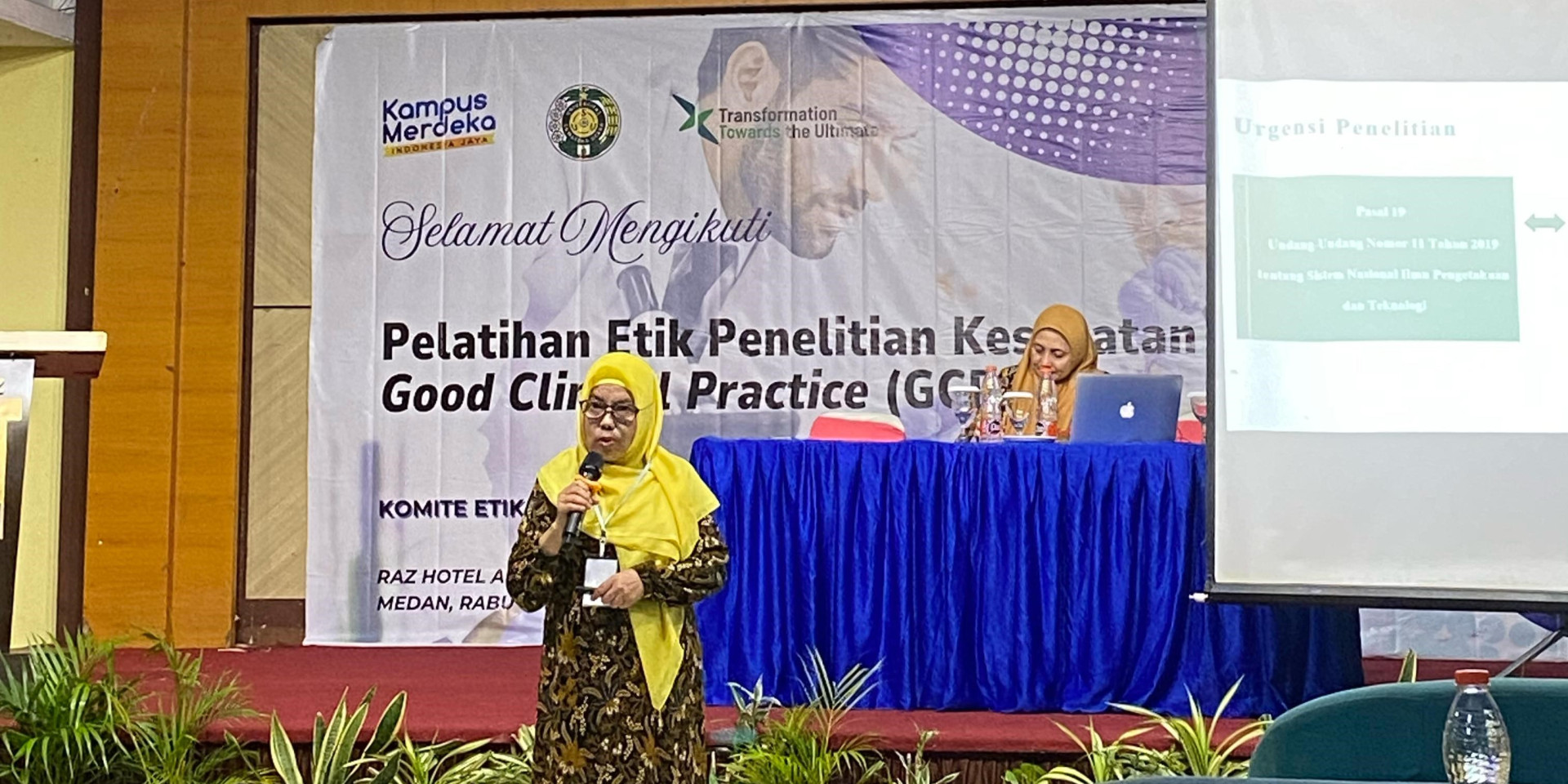
FH-USU PR: Wednesday (19/02/2025), The Medical Research Ethics Committee (KEPK) of the Faculty of Medicine of Universitas Sumatera Utara organized the "Health Research Ethics and Good Clinical Practice Training" at Raz Hotel and Convention Medan. This event was held to train doctors, healthcare professionals, medical students, and researchers in the health field.
The event began with a welcoming speech by Prof. Dr. dr. Juliandi Harahap, MA., FISPH., FISCM., Sp.KKLP, as the Head of the Health Research Ethics Committee of Universitas Sumatera Utara. This was followed by a speech from Vice Rector III of Universitas Sumatera Utara, Prof. Dr. Apt. Poppy Anjelisa Z. Hasibuan, M.Si. The first session of the event was led by Prof. Dr. dr. Dina Keumala Sari, M.Gizi., Sp.GK., as the moderator.
The first session began with the moderator introducing the first guest speaker, Prof. Dr. Sutomo Kasiman, Sp.PD., Sp.JP (K), who presented on "Principles of Health Research Ethics and the Role of the Research Ethics Committee." This was followed by the second guest speaker, Dr. dr. T. Ibnu Alferraly, M.Ked (PA)., Sp.PA., D Biopeth, who discussed "Stored Biological Materials and the Material Transfer Agreement (MTA)." The third guest speaker, Prof. Dr. Rosnidar Sembiring, S.H., M.Hum., delivered a presentation on "Legal and Ethical Aspects in Research" and concluded the first session.
"Ethics is a philosophy that underlies a principle. Research activities will be conducted properly and correctly (the right conduct) if ethical research principles are applied and adhered to. The ethical aspects of research are related to honesty, integrity, and responsibility toward research subjects, as well as maintaining confidentiality, anonymity, and respect," said Prof. Rosnidar as she opened her presentation.
"On the other hand, in any research activity or healthcare service provided by a researcher to a research subject, there is naturally a relationship between the two, which establishes certain boundaries, including their respective rights and obligations. This relationship then becomes a legal relationship that can also lead to legal consequences. Law as a set of rules with coercive and regulating characteristics will work in the relationship between researchers and health research subjects."
"If the research involves health studies, researchers must fulfill two legal obligations: obtaining ethical clearance and securing informed consent if the research subjects are human. Researchers are also required to protect the personal data of individuals serving as research subjects. Failure or negligence in complying with applicable research laws may result in liability based on breach of contract or unlawful conduct," explained Prof. Rosnidar.