


Public Relations FH-USU: Friday (14/10/2022)
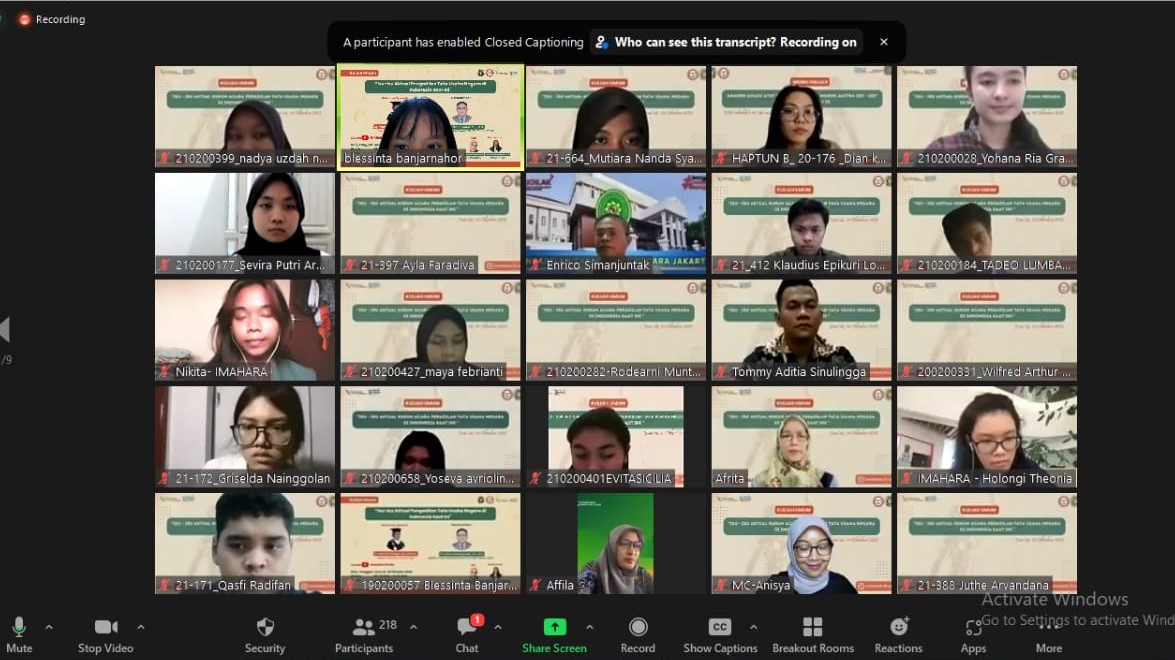
The Faculty of Law, Universitas Sumatera Utara, together with the State Administrative Law Student Association (IMAHARA) of the Faculty of Law, University of North Sumatra, held a Public Lecture (Online) on "Current Issues of State Administrative Court Procedure Law in Indonesia Today."
The public lecture activity began with remarks from Vice Dean 1 of the Faculty of Law, Universitas Sumatera Utara, Dr. Agusmidah, S.H., M.Hum, who expressed her gratitude for the willingness of the speakers and participants who attended. Furthermore, this public lecture session was opened and guided by Christine Purba SH, the moderator from the Faculty of Law, Universitas Sumatera Utara, featuring Dr. Enrico Simanjuntak, S.H., M.H., Jakarta PTUN Judge, as the speaker. "Why should there be a State Administrative Court?" asked Dr. Enrico Simanjuntak, S.H., M.H., the opening question for this Public Lecture. Enrico said that Indonesia is a country of law emphasized in the Indonesian constitution, so supervision from administrative justice cannot be avoided.
In the opening of this discussion, Dr. Enrico Simanjuntak, SH., M.H., greatly appreciated activities like this; he believes that there are three axes that students must do: reading, discussion, and writing. He explained the two integrated administrative justice systems: premium remedium (administrative law enforcement by the government or judicial curation) and ultimate remedium (administrative law enforcement by the judiciary). Furthermore, he also provided material related to the Source of Law, the Procedural Law of the State Administrative Court; there are three namely Primary, Secondary, and Tertiary Sources of Law. Regarding his explanation he also explained that administrative law is more concrete than the constitution itself. Dr. Enrico Simanjuntak, S.H., M.H also briefly told the story of the ups and downs of the authority of the State Administrative Court, which began with the enactment of Law No. 5/1986 concerning the State Administrative Court until entering the Era of the formation of special courts: Regression of Absolute Competence of the State Administrative Court. The era continued into the next era, namely the Progressive Era: Sectoral Law Policy and the issuance of Law No. 30 of 2014 concerning Government Administration. The third stage, where Law No. 11/2020 concerning Job Creation reduced the authority of the State Administrative Court: Regression of absolute competence of the State Administrative Court and the recently issued Constitutional Court Decision No. 37/PUU-XVIII of 2020 and No. 91/PUU-XVIII of 2020.
The explanation continued until the discussion could be concluded in 6 aspects: 1. The State Administrative Court Law has been amended twice; a third amendment is urgently needed. 2. Procedural law must be regulated by law (Article 24 paragraph (5) of the 1945 Constitution). 3. The urgency of harmonizing sectoral procedural law with general procedural law. Consolidation of norms in Perma and SEMA into the TUN Court Law. 4. Anticipation of convergence between administrative law and telematics law and the development of e-government practices. 5. Revitalization of procedural law to optimize administrative justice in the ideals of Indonesian law. 6. Synergy of TUN Court institutions with other administrative law enforcement institutions. Support from all stakeholders and civil society is needed to strengthen TUN Courts. In the discussion session, several points of response arose regarding the General Class "Actual Issues of State Administrative Court Procedural Law in Indonesia Today."
The attendees/participants asked about the existence of TUN Courts in the future to handle cases at PTUN. In addition, several disputes cannot pass through administrative appeals. Questions related to the absence of sanctions for TUN officials against negative and positive fictitious polemics, as well as discussions and discussions regarding implementing the Appeal Objection, which was not optimal to be carried out. This discussion was closed with a closing statement from Dr. Enrico Simanjuntak, S.H., M.H who stated that "Students should not be pragmatic because this country must be strong with the best cadres, especially since administrative law is very dynamic so that we can synergize with each other because the court does not only belong to judges and other legal apparatus. The point is that synergy between law enforcement officers and the community is expected to be more open.". This Public Lecture was attended by many law faculty students who were taking PTUN procedural law courses. Still, the raised theme made the law faculty lecturers enthusiastic about joining the discussion hosted by IMAHARA this time.