


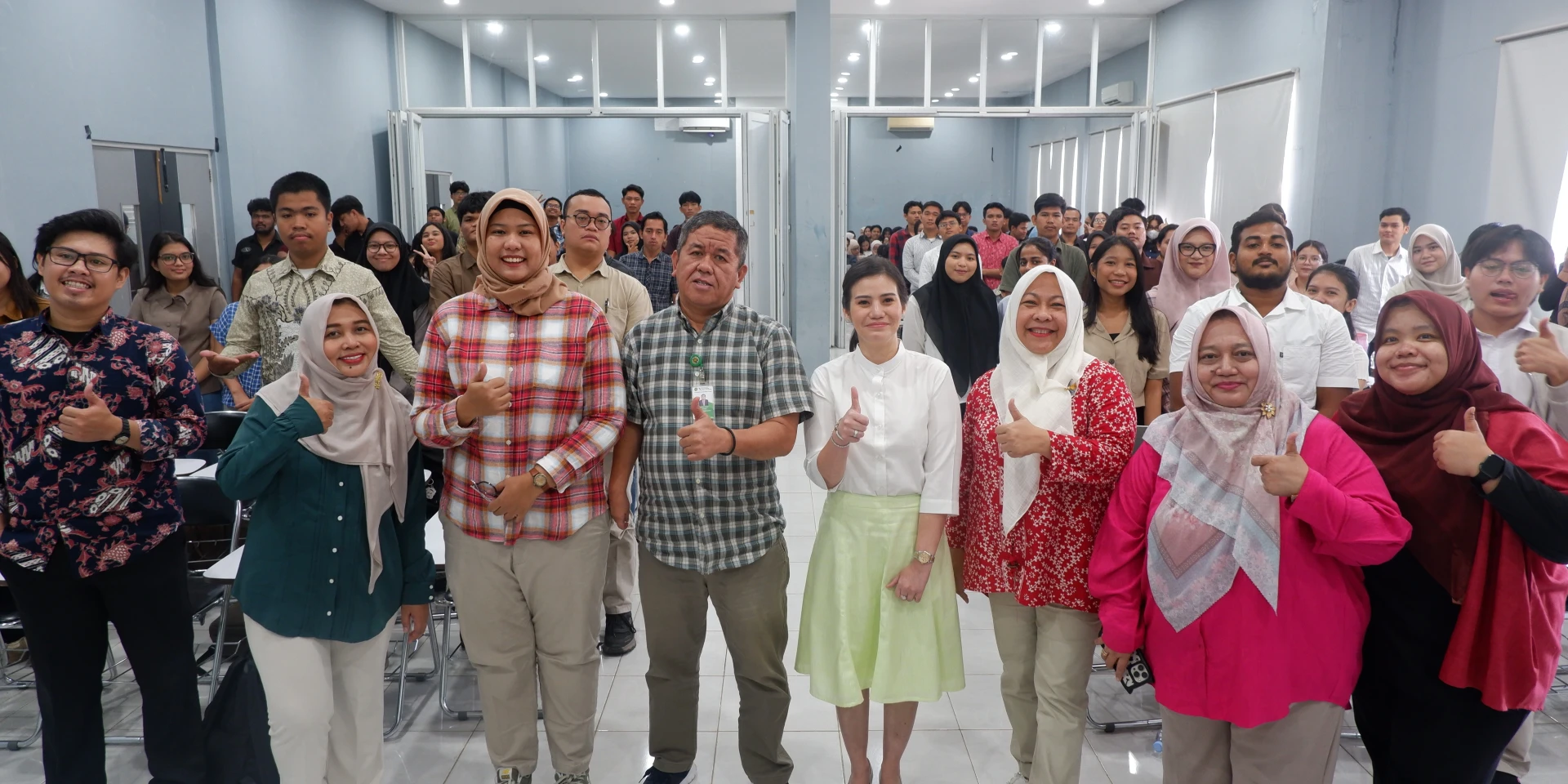
Public Relations of FH USU: Thursday (September 18, 2025) — The Faculty of Law, Universitas Sumatera Utara (FH USU), held a guest lecture featuring Dr. dr. Cashtry Meher, M.Kes., M.Ked(KK), Sp.DVE, MH.Kes., FINSDV, discussing the topic “Responsibilities of Dermatologists and Aesthetic Doctors in Aesthetic Treatments.” The event took place at the H. Anif Joint Building and was attended by FH USU students and lecturers teaching Health Law.
In his opening remarks, the Dean of FH USU explained that health law has been incorporated into the curriculum as a response to societal developments and the evolving paradigm in law, known as “the emerging paradigm,” where law increasingly focuses on promoting public welfare. Future legal discourse, he added, will center around human rights, environmental issues, and the protection of vulnerable groups such as women, children, and persons with disabilities, including issues related to health.
“The Faculty of Law at USU includes Health Law as one of the subjects taught to students because it is a complex area encompassing multiple legal dimensions, such as civil law, administrative law, criminal law, international law, and economic law. Therefore, it is a crucial field of study,” stated the Dean. "Today, we will discuss one aspect of Health Law: medical services and professional responsibilities of healthcare providers. It is essential to understand the rights and obligations of medical professionals as well as those of patients,” he added.
In her lecture, Dr. dr. Cashtry Meher emphasized that medical practice in Indonesia is inseparable from the law, and aesthetic practices must adhere to legal regulations rather than merely follow beauty trends. She explained that aesthetic procedures are regulated, stating, “Patients must be educated that injections or medications should only be used with legally approved products. There is no justification for using instant injectable products without distribution permits,” she said. At the conclusion of her lecture, Dr. dr. Cashtry underscored that “illegal production destroys trust, illegal distribution endangers safety, and both can only be stopped through legal compliance and professional responsibility."