


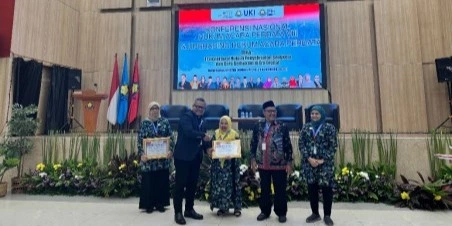
FH USU-Public Relations: Wednesday to Friday (19–21 November 2025), a Professor of the Faculty of Law at Universitas Sumatera Utara (FH USU), Prof. Dr. Rosnidar Sembiring, S.H., M.Hum, served as one of the speakers at the Eighth National Conference on Civil Procedural Law and the Civil Procedural Law Upgrading held by the Association of Civil Procedural Law Lecturers (ADHAPER) with the general theme “Transformation of Dispute Resolution Law and Legal Practices in the Digital Era,” held at the Faculty of Law, Universitas Kristen Indonesia Jakarta.
The event was officially opened by Prof. Dr. Efa Laela Fakhriah, S.H., M.H., as Chairperson of ADHAPER, followed by Prof. Dr. H. Sunarto, S.H., M.H., Chief Justice of the Supreme Court of the Republic of Indonesia for the 2024–2029 period, who served as the keynote speaker. The opening session also featured remarks from Prof. Edward Omar Sharif Hiariej (Deputy Minister of Law of Indonesia), Prof. Dr. rer. Pol. Ied. Veda Rimrosa Sitepu, S.S., M.A. (Vice Rector for Student Affairs, Alumni, and Legal Affairs of UKI), and Mr. Thomas Tampubolon (UKI Foundation).
During the second Plenary Session of the Civil Procedural Law Upgrading, Prof. Dr. Rosnidar Sembiring, S.H., M.Hum, delivered a presentation on “Judge Decisions in Civil Cases.” The presentation began with the definition of judicial decisions according to legal experts, the structure of decisions, including elements that constitute the formulation of a decision, the types of decisions viewed from the presence of parties and their nature, and legal remedies against judicial decisions, including ordinary and extraordinary legal remedies. If a decision does not follow the structure required by the relevant legal provisions, the decision may be invalid and subject to annulment. An example is the Supreme Court Jurisprudence Decision No. 132k/Sip/1974, which annulled a District Court decision for failing to include the formulation of the claim’s posita or the subject matter of the case, and for failing to include the defendant’s answer, even though the answer was accompanied by a counterclaim. Such a decision contradicts Article 184 paragraph (1) of the HIR. Civil decisions are not ultra petita, meaning first, the court may not grant more than what is requested, and second, the court may not grant matters that were not requested.
Civil Procedural Law plays a central role in upholding justice in Indonesia. On the other hand, it is also a fundamental instrument in law enforcement, especially in resolving disputes in the private law domain. However, the rapidly developing social, economic, and technological dynamics demand an upgrading of civil procedural law so that it can respond to contemporary challenges. This situation becomes even more complex with the presence of information technology and the digitalization of the judiciary. The Supreme Court has issued Supreme Court Regulation (Perma) Number 3 of 2018 on Electronic Case Administration in Courts and Perma Number 1 of 2019 on Electronic Case Administration and Hearings in Courts (e Court and e Litigation).
In response to these developments, the Association of Civil Procedural Law Lecturers (ADHAPER), together with academics, practitioners, and legal stakeholders, is expected to contribute ideas and strategic recommendations regarding the reform of civil procedural law. Through the Civil Procedural Law Upgrading activities, participants are expected to gain renewed understanding and strengthened mastery of the subject matter. This momentum is important so that Indonesia’s civil procedural law does not function solely as procedural rules but also as an instrument to achieve legal certainty, justice, and benefit in the resolution of civil disputes in the modern era.