


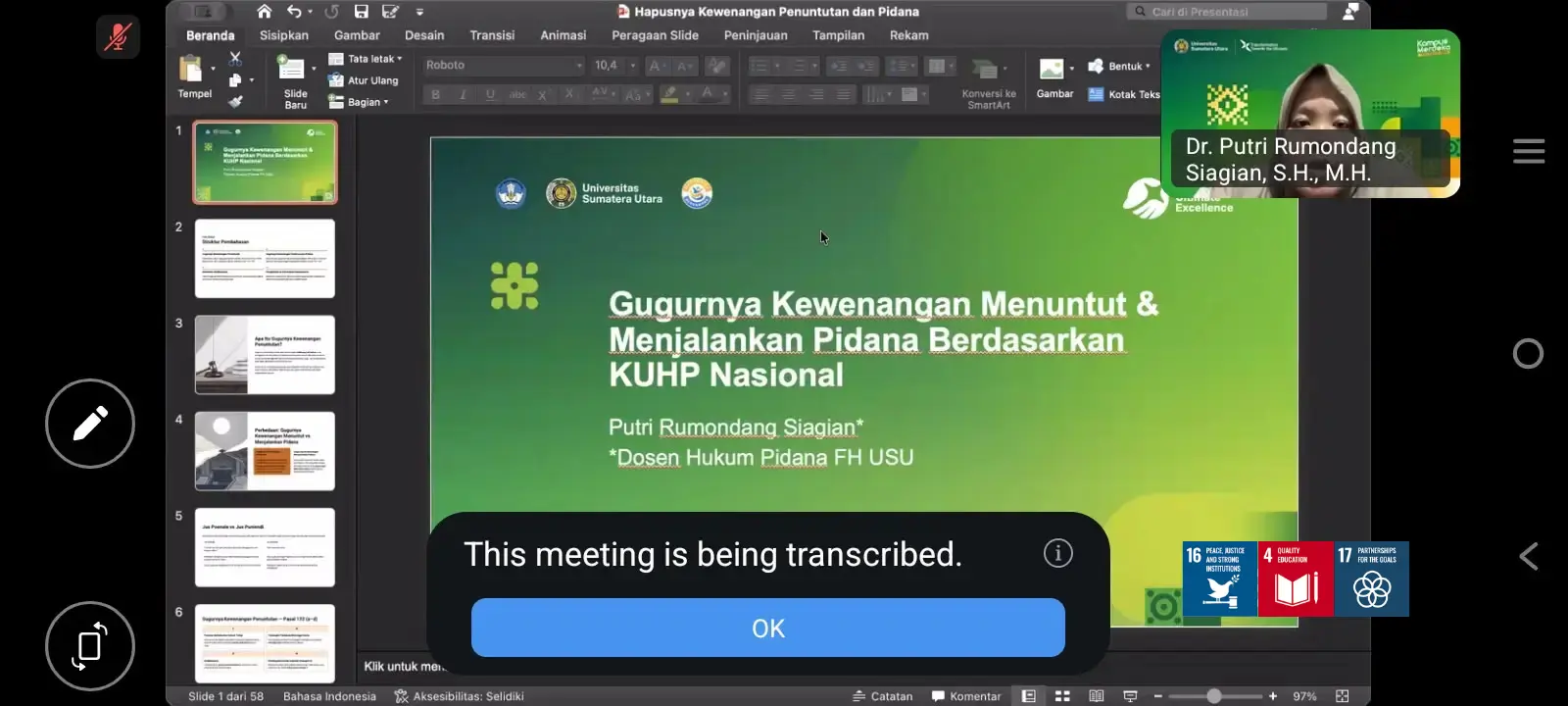
Humas-FHUSU: (02/05/2026) The Faculty of Law, Universitas Sumatera Utara (FH USU), once again demonstrated its active role in the advancement of legal scholarship and the capacity building of law enforcement officers through the participation of one of its lecturers as a speaker in the National Criminal Code (KUHP) Dissemination Program organized by the Ambarsan Legal Aid Foundation (YLBH Ambarsan).
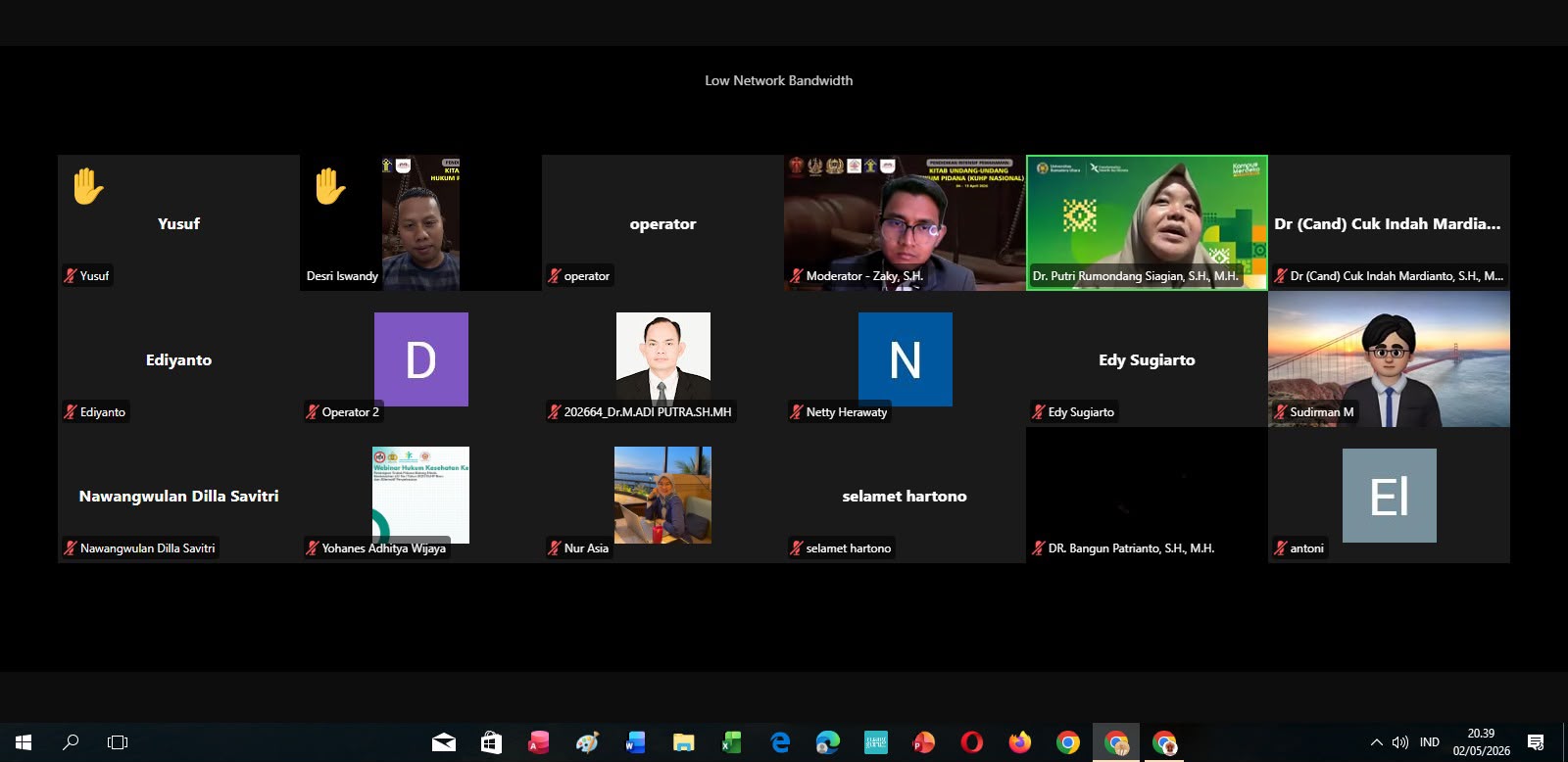
The program was held online via Zoom Meeting on Saturday, 2 May 2026, from 7:30 p.m. (WIB) until completion, featuring Dr. Putri Rumondang Siagian, S.H., M.H., a lecturer at the Faculty of Law, Universitas Sumatera Utara, as the keynote speaker.
During the event, Dr. Putri Rumondang Siagian delivered a presentation entitled "The Extinction of the Authority to Prosecute and Enforce Criminal Sentences under the National Criminal Code," a significant topic within Indonesia's criminal law reform following the enactment of Law No. 1 of 2023 on the Criminal Code, which came into effect in 2026.
The dissemination program was organized to enhance participants' competence and comprehensive understanding of developments in Indonesia's national criminal law, particularly among law enforcement officers and legal practitioners. It also served as a strategic platform to support adaptation to regulatory changes that directly affect Indonesia's criminal justice system.
In her presentation, the speaker emphasized the importance of a thorough understanding of the concept of the extinction of the authority to prosecute and enforce criminal sentences as part of the principles of legal certainty and the protection of human rights. This understanding is essential to ensuring that law enforcement is carried out fairly, proportionately, and in accordance with the development of modern legal principles.
FH USU's participation in this program reflects the institution's commitment to fulfilling the Tri Dharma of Higher Education, particularly in the areas of community service and the advancement of legal knowledge. The involvement of academics in legal dissemination activities is expected to bridge the gap between legal theory and practice while making a meaningful contribution to improving the quality of law enforcement in Indonesia.
The program also highlighted the importance of collaboration between higher education institutions and legal aid organizations in promoting access to justice. Such synergy plays a vital role in developing a legal system that is responsive, inclusive, and equitable.
In line with these objectives, the program contributes to the achievement of the Sustainable Development Goals (SDGs), particularly:
- SDG 16 (Peace, Justice and Strong Institutions) by strengthening the justice system, enhancing the capacity of law enforcement officers, and promoting fair law enforcement;
- SDG 4 (Quality Education) through the dissemination of legal knowledge and the improvement of legal literacy;
- SDG 17 (Partnerships for the Goals) through collaboration between FH USU and YLBH Ambarsan in legal education initiatives.
Through this program, it is expected that understanding of the new National Criminal Code will continue to improve, enabling its implementation to be carried out effectively, fairly, and in a manner that provides legal certainty for all members of society.