


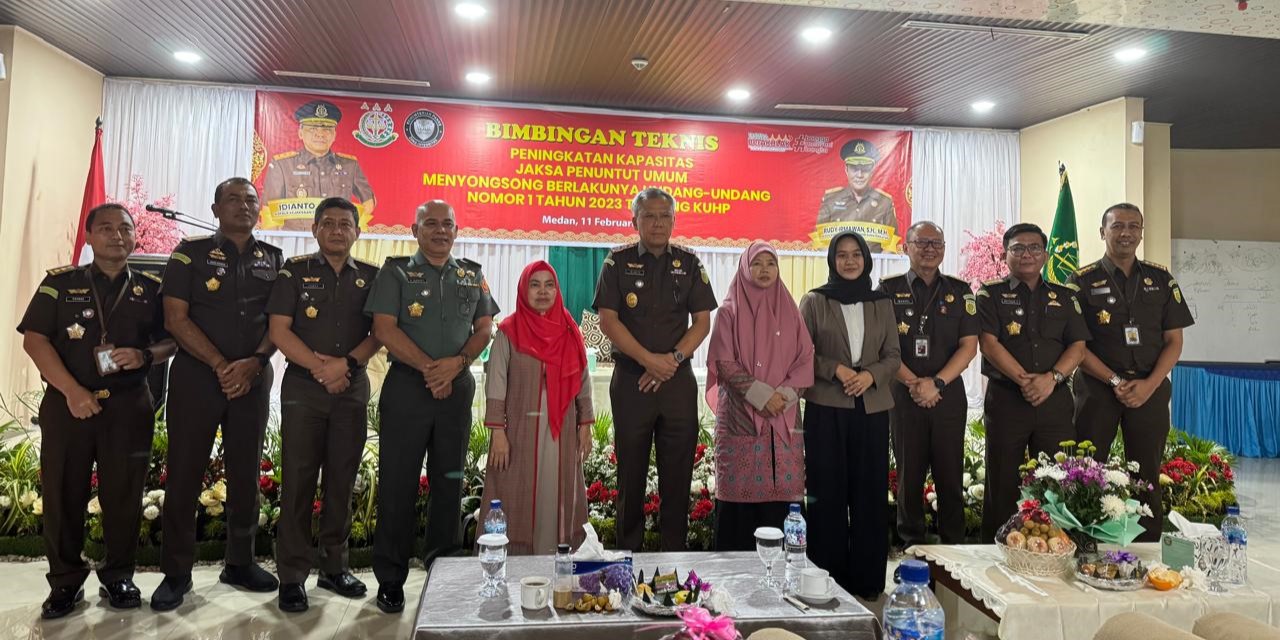
FH-USU PR: Tuesday (11/02/2025), The North Sumatra High Prosecutor's Office organized an activity titled "Technical Guidance: Enhancing the Capacity of Public Prosecutors in Anticipation of the Implementation of Law No. 1 of 2023 on the Criminal Code (KUHP)," at the Asrama Haji Building Medan. This activity was held to guide Public Prosecutors, as part of the "Law Enforcement" sector, in implementing Law No. 1 of 2023 on the Criminal Code (KUHP), which was enacted and promulgated on January 2, 2023, and will come into effect in January 2026.
The first guest speaker, Prof. Dr. Rosnidar Sembiring, S.H., M.Hum., discussed "The Application of Customary Law or Living Law in North Sumatra Province Under Law No. 1 of 2023 (Norms and Sanctions)." This was followed by the second guest speaker, Dr. Marlina, S.H., M.Hum. The event was attended by Mr. Idianto, S.H., M.H., Head of the North Sumatra High Prosecutor's Office; Mr. Rudy Irmawan, S.H., M.H., Deputy Head of the North Sumatra High Prosecutor's Office; as well as Heads of District Prosecutor's Offices, Heads of Branch Prosecutor's Offices, Section Heads, and Subdivision Heads within the jurisdiction of the North Sumatra High Prosecutor's Office.
The Dutch colonial legacy Criminal Code (KUHP) (Wetboek van Strafrecht) has been replaced by Law No. 1 of 2023 on the Criminal Code, which was enacted and promulgated on January 2, 2023, and will take effect in January 2026. This new Criminal Code consists of 37 chapters, 624 articles, and 345 pages. The replacement was necessary as the old code no longer aligns with society's evolving demands and values. However, despite the legal unification efforts since 1918, the tradition of accommodation has not been entirely eliminated," said Prof. Rosnidar in her opening presentation.
"Customary Criminal Law holds a strategic position in UU No. 1 of 2023, particularly in Article 2 paragraphs (1), (2), and (3), as well as Articles 51 and 66. The law is created by society, and its function is to serve the people's interests. Legal harmonization is one of the efforts in national legal reform, which aligns with the nation's character. Harmonization is an effort to align and unify laws to create coherence and consistency."
"Evidence of the application of Customary Law/Living Law in criminal law enforcement can be found in Constitutional Court Decision No. 3898/K/Pdt/1989: When two consenting adults engaged in a relationship resulting in the woman's pregnancy, the man was subjected to customary sanctions requiring him to provide belis (dowry), which in this case was a cow. Another example is Constitutional Court Decision No. 1644/K/Pid/1988, which ruled that engaging in sexual relations outside of marriage is a criminal offense," explained Prof. Rosnidar.