


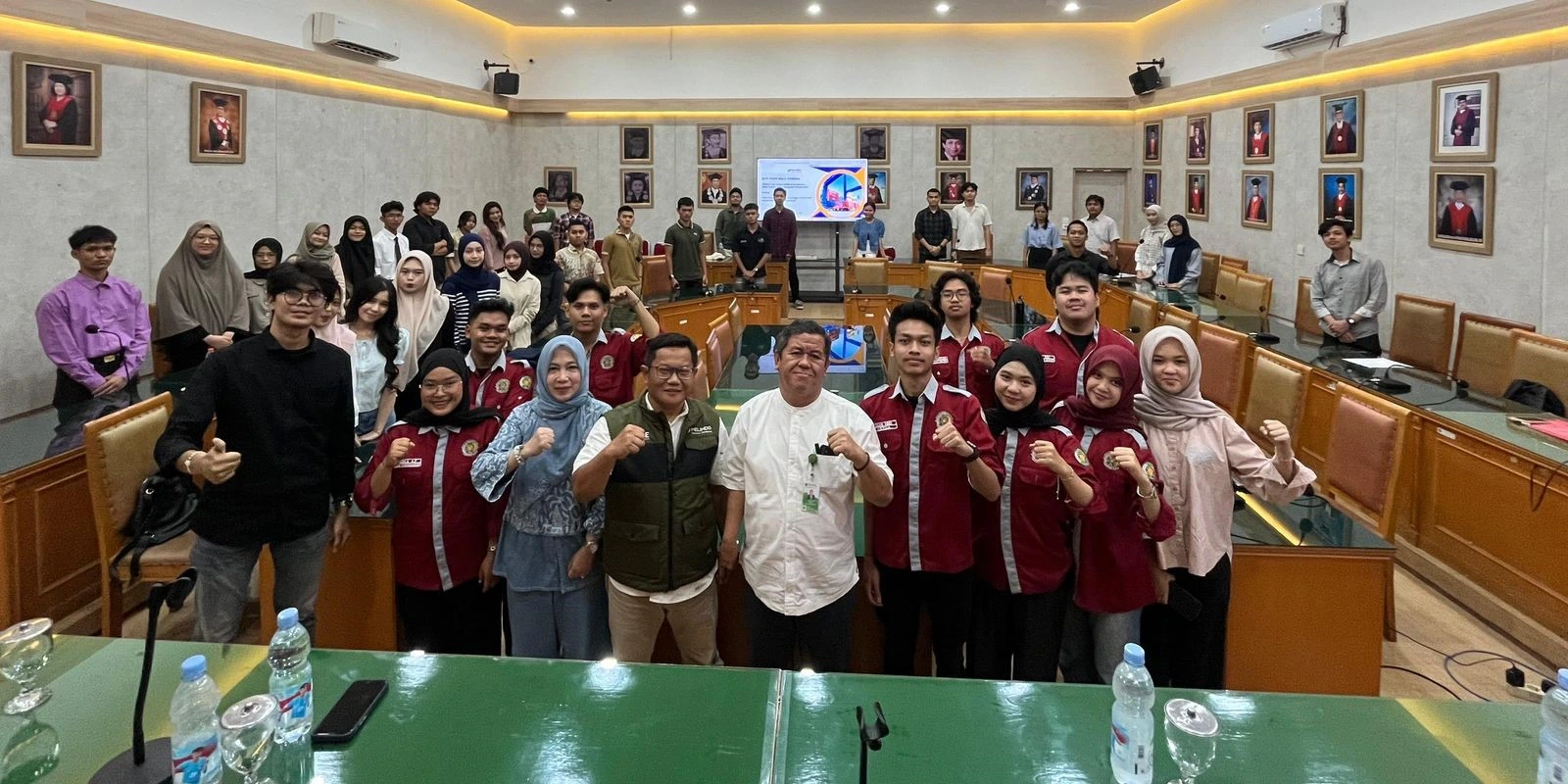
PUBLIC RELATIONS FH-USU: On Friday (July 11, 2025)
To broaden students' horizons regarding the practical world of state-owned enterprise governance, the Student Executive Board (BEM) of the Faculty of Law, University of North Sumatra (FH USU), through the Political Diplomacy Department, with Amir Fauzi as the head of the department, held a discussion entitled "Reflections on State-Owned Enterprise Governance in the Modern Era: The Role of Law in Ensuring Good Corporate Governance." The event took place in the Faculty Advisory Council (DPF) Room and was open to all active Faculty of Law, USU students.
The event featured speakers from PT Pelabuhan Indonesia (Pelindo), a state-owned enterprise (SOE) with a strategic role in managing the maritime logistics sector in Indonesia. The invited speakers were Sri Suyono, S.H., M.Hum., Head of SPI PT. PMT, and Ade Maydwiyanda, S.E., M.M., General Manager and HR PT. PMT. The BEM also invited the Dean of the Faculty of Law, Dr. Mahmul Siregar, S.H., M.Hum., also delivered remarks and provided introductory material to the forum. Through this activity, the USU Faculty of Law Student Executive Board (BEM FH USU) aims to foster students' understanding of the importance of Good Corporate Governance (GCG) principles in the corporate governance system, as well as the role of law as a primary guardian in ensuring integrity, transparency, and accountability in the management of state-owned enterprises (SOEs) in Indonesia.
Implementing GCG principles in SOEs is a normative obligation and a strategic necessity for ensuring professional, efficient, and accountable corporate governance. The presentation emphasized that GCG is not merely a formality but a key foundation for building public trust and ensuring business sustainability amidst increasingly fierce global competition.
The role of law in this context is vital. It serves not only as a regulatory instrument but also as a control mechanism for corporate practices to ensure they remain within the boundaries of transparency, accountability, and social responsibility. During the discussion, the speakers also reviewed several important regulations that form the basis for GCG implementation in Indonesia, including Law Number 19 of 2003 concerning State-Owned Enterprises (SOEs), Regulation of the Minister of SOEs Number PER-01/MBU/2011 concerning the Implementation of Good Corporate Governance (GCG), and other legal provisions governing corporate integrity and ethics.
PT Pelindo, a state-owned enterprise operating in the national port and logistics sector, is an example of GCG practices that have improved over time. Through institutional transformation and improved managerial integrity, Pelindo has demonstrated various efforts to build a corporate culture that upholds transparency, stakeholder participation, and efficiency in managing state assets.
Students participating in the activity were invited to interact directly with how legal regulations can be translated into concrete managerial actions. The speakers also explained the strategies and challenges faced in implementing GCG in the field, including how companies deal with bureaucratic obstacles and the potential for conflict within large and complex structures.
Furthermore, students also understood the importance of external oversight bodies such as the Supreme Audit Agency (BPK) and the Corruption Eradication Commission (KPK), and the role of internal audit in ensuring proper and objective GCG implementation.
This activity took place in an interactive and lively atmosphere. Students were highly engaged in the discussion, as evidenced by the numerous critical questions posed to the speakers. As prospective law graduates, USU Faculty of Law students play a crucial role in understanding and overseeing the implementation of sound governance principles in all aspects of life, including the management of state-owned enterprises (SOEs). Therefore, this activity served not only as an academic forum but also as a reflective space that fostered students' critical awareness of the realities of law and the Indonesian corporate world.
Through this activity, the Faculty of Law Student Executive Board (BEM) hopes to develop students' intellectual capacity to respond to strategic national issues, particularly in the field of state-owned enterprise law and governance. Discussions like this will continue to be held regularly as a form of student contribution to the development of applicable legal knowledge relevant to the challenges of the times.
The USU Faculty of Law Student Executive Board (BEM) is also committed to continuing to be a driver of change and a pioneer in proactive legal education. By presenting speakers from the professional world, students learn theory and understand how law is implemented in real-life practice.
This activity reminds us that, in facing the challenges of the modern era, synergy between education, the business world, and the legal system is crucial for building healthy, clean, and sustainable governance.