


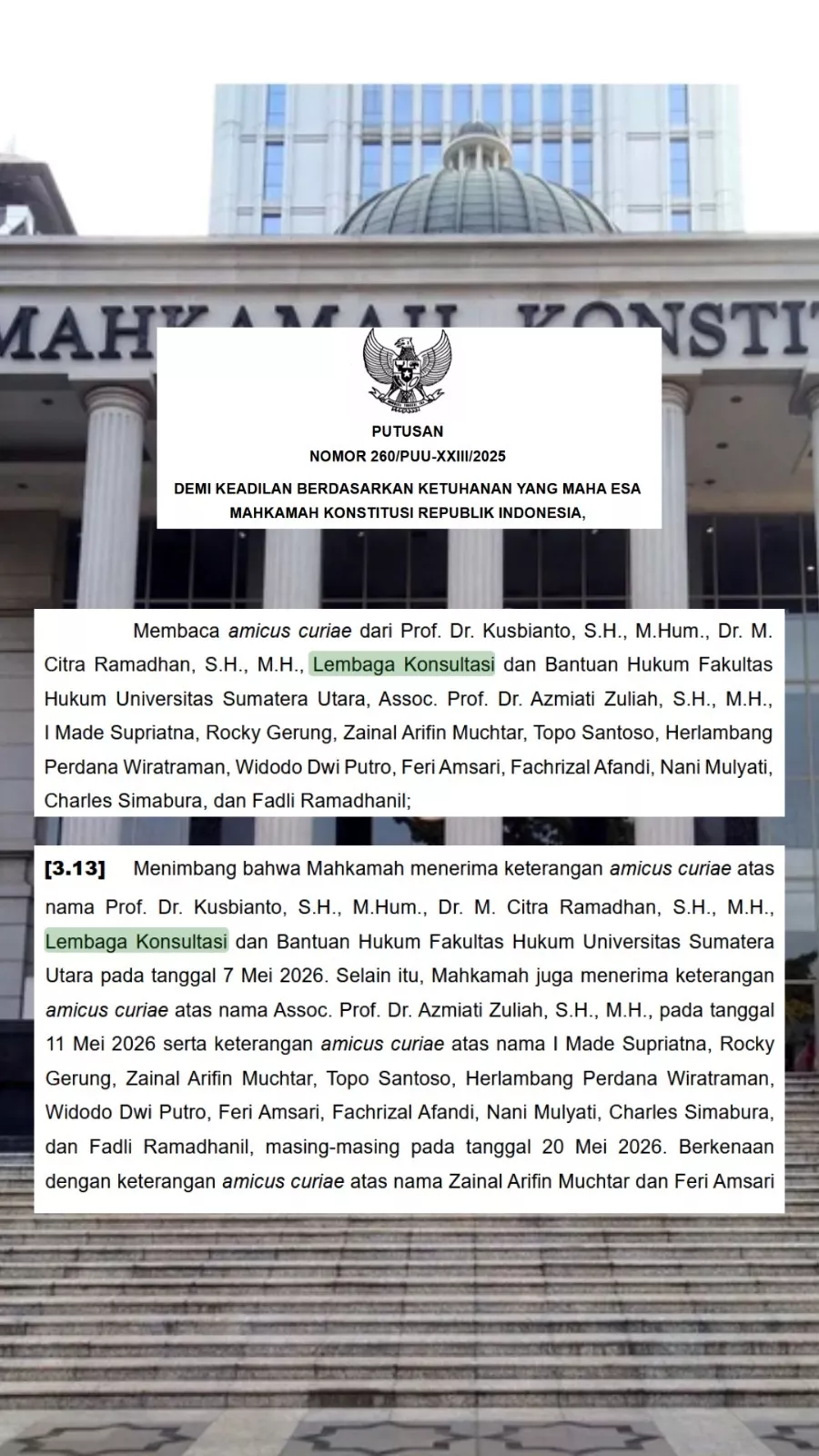
On Thursday (October 15, 2026), the Constitutional Court (MK) delivered its Decision No. 260/PUU-XXIII/2025. In the decision, the Court granted all requests submitted by the Petitioners. The case concerned a judicial review of Law No. 31 of 1997 concerning Military Courts.
During the examination of the case, the Legal Consultation and Aid Institute of the Faculty of Law, Universitas Sumatera Utara (LKBH FH USU), submitted an Amicus Curiae (Friend of the Court) to the Constitutional Court. The document, dated May 6, 2026, was sent by email on May 7, 2026.
The petition was filed by Lenny Damanik and Eva Meliani Br Pasaribu. Lenny Damanik is the mother of a 15-year-old child who died as a result of assault by a member of the Indonesian National Armed Forces (TNI). The case was examined and tried at Military Court I-02 Medan. Eva Meliani Br Pasaribu is the daughter of the late Rico Sempurna Pasaribu, a journalist who died in a house-burning incident in Karo Regency in June 2024. Alleged involvement by a TNI soldier in the incident had not resulted in any significant progress in the investigation.
The Petitioners challenged Article 9 point 1, Article 43 paragraph (3), and Article 127 of the Military Courts Law. They argued that these provisions contradicted Article 1 paragraph (3), Article 24 paragraph (1), Article 27 paragraph (1), and Article 28D paragraph (1) of the 1945 Constitution of the Republic of Indonesia.
The Amicus Curiae submitted by LKBH FH USU was prepared by Dr. Tommy Aditia Sinulingga, S.H., M.H., and Muhammad Naufal Nazali, S.H. The document highlighted five key issues:
- The history of military courts in Indonesia, from the Dutch East Indies era to Law No. 31 of 1997.
- The principles of the rule of law and the prohibition of impunity in handling ordinary criminal offenses committed by military personnel.
- The independence of judicial power and the appropriate allocation of judicial jurisdiction.
- The principle of equality before the law.
- Constitutional guarantees for the protection of citizens and legal certainty.
In its recommendations, LKBH FH USU presented three points for the consideration of the Constitutional Court justices:
- Article 9 point 1 of the Military Courts Law should be interpreted as applying only to military offenses. Ordinary criminal offenses, even when committed by TNI members, should be examined and decided by the general courts.
- Article 43 paragraph (3) and Article 127 should be revised to ensure the independence of judicial power.
- The Constitutional Court could consider issuing a conditionally constitutional ruling to provide an interpretation of the provisions of the Military Courts Law.
The submission of this Amicus Curiae formed part of community service under the university's Three Pillars of Higher Education (Tridarma Perguruan Tinggi). LKBH FH USU considered it important to provide legal perspectives on developments in national law, particularly in cases involving broad public interests.
The Constitutional Court's decision also serves as a reminder that academics and legal aid institutions can contribute broader legal perspectives to the constitutional review of legislation.