


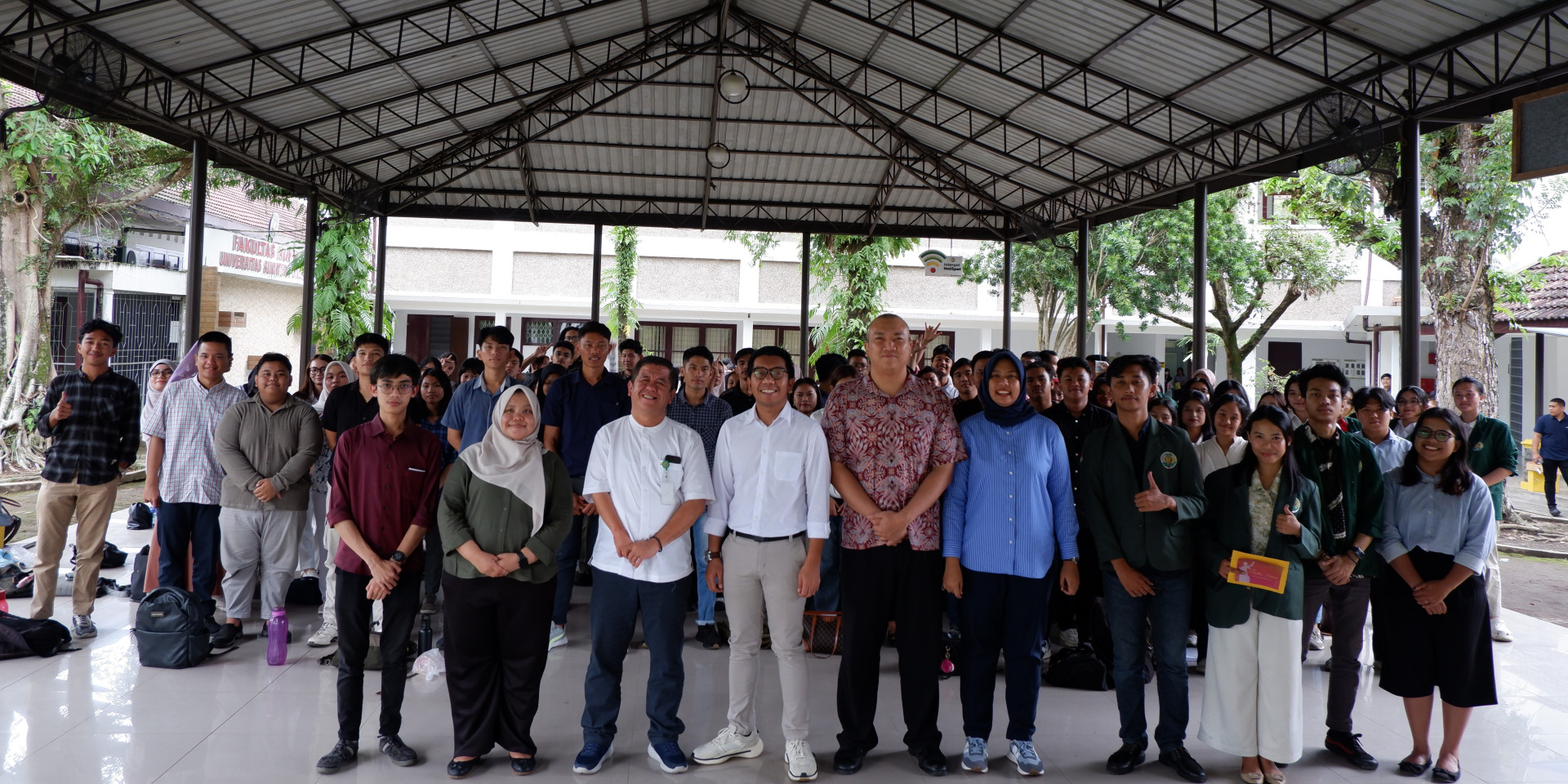
FH-USU PR: On Thursday (27/02/2025), The Alumni Teaching event in celebration of the Anniversary of FH USU was held once again, featuring an alumnus of FH USU, Kurnia Ramadhana, S.H., who is an activist and a former researcher at the Indonesian Corruption Watch (ICW). The event took place at the Pendopo of FH USU and was attended by Law Faculty students from various specializations.
In his speech, the Dean of FH USU, Dr. Mahmul Siregar, S.H., M.Hum., once again emphasized the purpose and objectives of organizing the Alumni Teaching event as part of the Scientific Week of FH USU's Anniversary. He reiterated the importance of this event in strengthening the bond between the campus and its alumni, who have succeeded in their respective fields and professions. Additionally, this event is expected to stimulate students to plan their studies and career paths after they graduate.
The moderator, Gray Anugrah Sembiring, a class of 2021 USU Faculty of Law student, opened the event. Kurnia Ramadhana interactively delivered his presentation to the students. He began by outlining key points on the reflection and projection of corruption law enforcement in Indonesia, starting with an explanation of the relationship between law and politics, followed by an overview of the 10-year administration of President Jokowi and the first 100 days of President Prabowo's administration. He then pointed out that nearly all public positions have contributed to corruption cases, primarily involving individuals from political backgrounds.
Kurnia also explained the government's weak commitment to enforcing laws against corruption in Indonesia. He highlighted how President Jokowi's campaign promises on corruption eradication were not realized during his administration, the weakening of the Corruption Eradication Commission (KPK) through the revision of the KPK Law, and the reduction of penalties for corruption offenders in the 2023 Criminal Code (KUHP). He also pointed out the lack of commitment in other institutions, such as the House of Representatives (DPR) failing to follow up on the Asset Forfeiture Bill and the selective handling of cases by the Indonesian National Police (Polri). He noted that reports from public officials against crimes committed by citizens are often processed efficiently, whereas reports from citizens against public officials tend to receive less attention. This situation has pushed the public to become more active in monitoring corruption through social media.
However, Kurnia further explained that the freedom of expression for the public to criticize government performance is now facing challenges not only in the form of physical threats, such as the acid attack on Novel Baswedan but also psychological threats. These psychological threats include doxing—the public dissemination of personal information—targeting individuals who criticize the government, carried out by unidentified individuals in retaliation for their criticism. Kurnia illustrated this situation with his own experience, recounting how an unknown party doxed him after criticizing a public official.
At the end of the event, Gray Anugrah Sembiring, as the moderator, delivered a conclusion that underscored how law enforcement against corruption remains a political bargaining commodity. He also pointed out the stagnation in corruption law enforcement from President Jokowi's administration to President Prabowo Subianto's administration.