


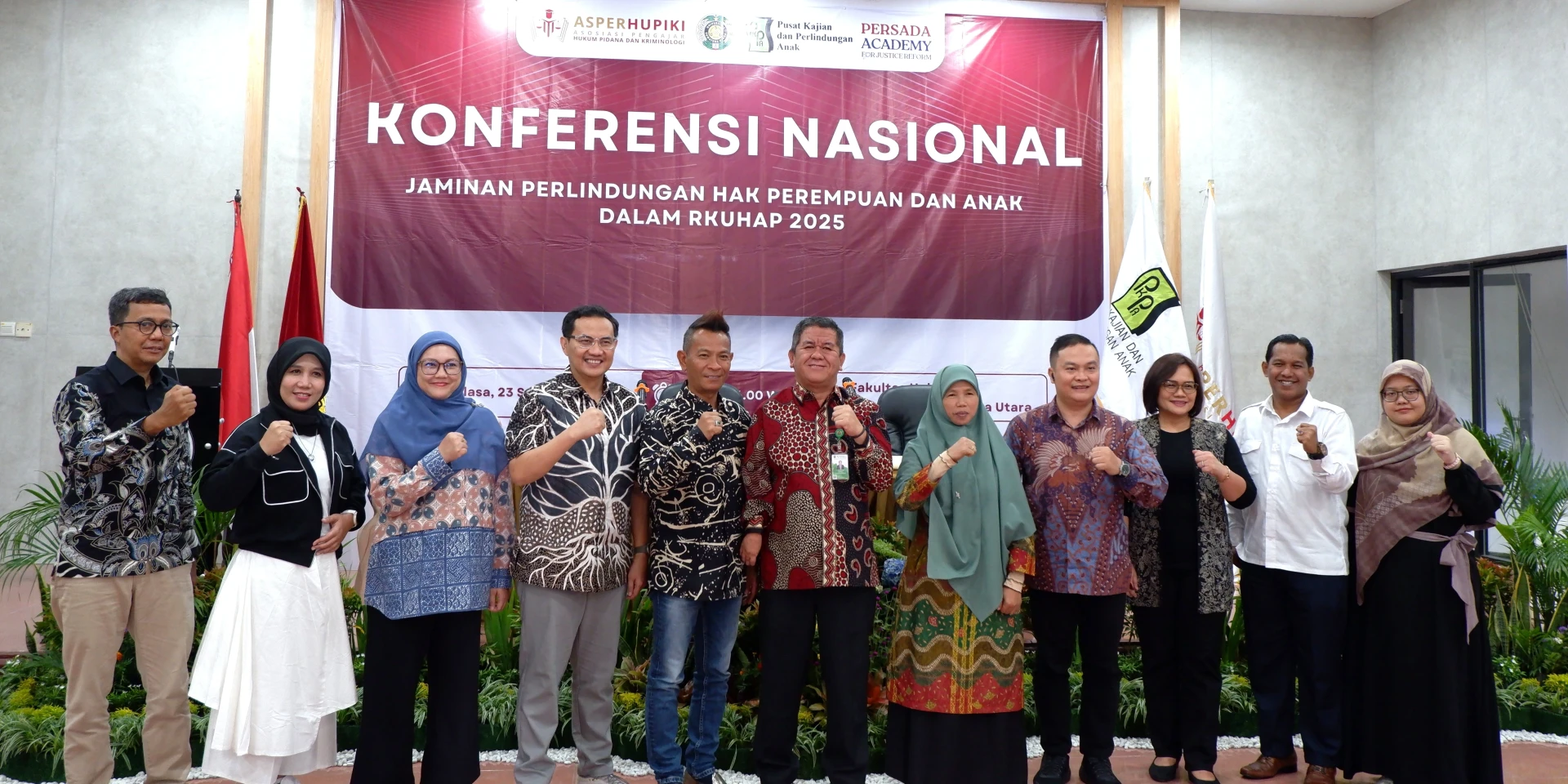
Public Relations FH-USU: Tuesday (September 23, 2025) — The Association of Criminal Law and Criminology Lecturers (ASPERHUPIKI), in collaboration with the Faculty of Law, Universitas Sumatera Utara (FH USU), the Center for Child Study and Protection Foundation (PKPA), and Pesada Academy, successfully held the National Conference on “Guaranteeing the Protection of Women’s and Children’s Rights in the 2025 Draft Criminal Procedure Code (RKUHAP)” at the Moot Court Building, Faculty of Law, USU.
The conference served as a forum to examine and discuss the extent to which the 2025 Draft Criminal Procedure Code (RKUHAP) which replaces the 1981 Criminal Procedure Code (KUHAP)—accommodates the protection of women’s and children’s rights. Despite existing regulations that aim to safeguard the rights of women and children, recent data show that these vulnerable groups continue to experience violence and remain inadequately protected within the justice system. According to the National Commission on Violence Against Women (Komnas Perempuan), there were 2,078 cases of sexual violence recorded in 2023. Meanwhile, data from the Ministry of Women’s Empowerment and Child Protection (KemenPPPA) indicate that 70% of human trafficking victims are women and children. These figures underscore the urgent need for deeper reforms within Indonesia’s criminal justice system, particularly in ensuring the protection of women and children’s rights.
Keumala Dewi, Executive Director of PKPA, stated that the conference sought to move beyond discussions of law enforcement to strengthen the child protection system and urge government institutions to give greater attention to children affected by legal processes. “The main focus is to ensure that RKUHAP 2025 is not merely a procedural reform, but also an incorporation of human rights guarantees particularly physical, psychological, and legal protections for women and children as vulnerable groups in the criminal justice system,” she said. She also emphasized that the event aimed to bring forward perspectives from assisted groups. Both children under PKPA’s care and children of convicted parents were consulted to share stories and testimonies about the hardships they face, including the loss of basic rights as a result of their parents’ legal processes.
Dean of FH USU, Dr. Mahmul, S.H., M.Hum., stressed that law must not only serve as a binding instrument but also uphold justice in a way that humanizes people. Therefore, this conference provided an important platform to formulate constructive recommendations for developing a more just, humane, and responsive legal system in Indonesia, particularly for vulnerable groups. During the conference, a Memorandum of Understanding (MoU) was signed between ASPERHUPIKI, FH USU, PKPA, and Pesada Academy to strengthen collaboration and implementation of women’s and children’s rights protection within the framework of criminal procedural law.
In his keynote speech, Chairperson of ASPERHUPIKI, Fachrizal Afandi, S.Psi., S.H., M.H., Ph.D., highlighted the importance of addressing vulnerabilities within the legal enforcement framework of RKUHAP. “RKUHAP must be able to address the shortcomings that have long made women and children vulnerable to discrimination and violence in the criminal justice system,” he stated. He further noted that Indonesian law remains largely focused on law enforcement against men, often neglecting gender-specific dimensions of criminal acts involving women.
Criminal procedure law, in essence, is designed to limit the powers of law enforcement officials to prevent abuse of power and ensure proportional justice. This point was reinforced by Dr. Beniharmoni Harefa, S.H., M.A., who stated that RKUHAP still requires improvement, especially concerning child and women protection, although some aspects have begun to incorporate restorative justice principles.
“These improvements are essential to ensure that Indonesia’s criminal justice system truly responds to the needs of vulnerable groups, not merely focusing on punishment but also prioritizing protection and recovery for victims,” he explained. Meanwhile, Dr. Nathalina Naibaho, S.H., M.H., emphasized the importance of regulatory synchronization to ensure that the protection of women and children is not just a slogan but a tangible legal reality.
Additionally, Dr. Mahmud Mulyadi, S.H., M.Hum., highlighted the various regulatory, social, structural, and cultural barriers that continue to hinder access to justice for vulnerable populations. Finally, Dr. Marlina, S.H., M.H., presented a comprehensive discussion on diversion and restorative justice approaches, underscoring the need for legal processes that not only focus on punishment but also facilitate recovery for victims, particularly women and children affected by crime.