


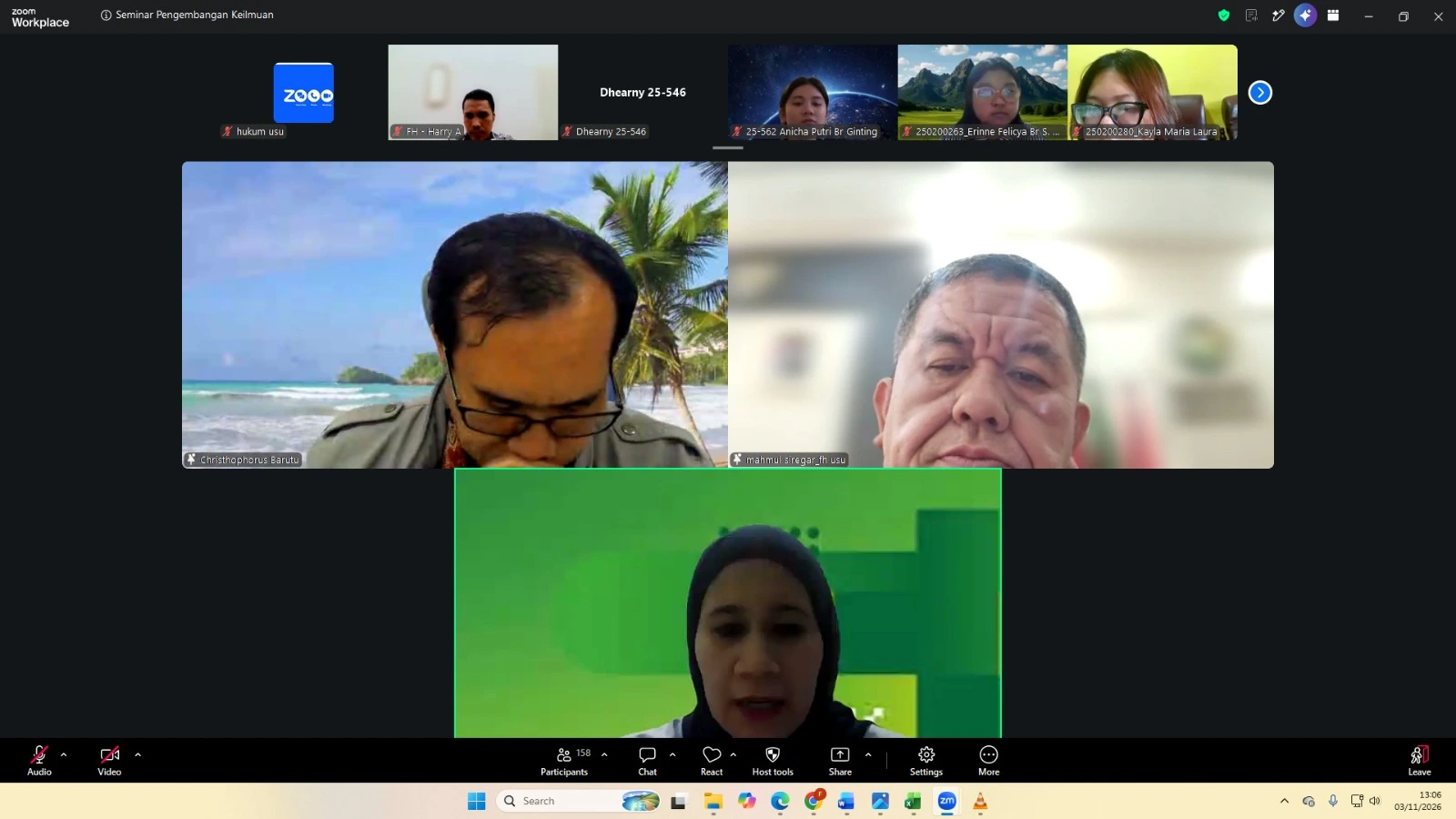
Medan, November 3, 2026 – The Faculty of Law, Universitas Sumatera Utara (USU), held an Academic Development Seminar entitled “The Dynamics of International Trade Law: The Effectiveness of WTO Dispute Settlement and the Implementation of IA-CEPA in Supporting Sustainable Development” on Tuesday (November 3, 2026), online via Zoom Meeting.
The event featured Christhophorus Barutu, S.H., M.H., a 1994 alumnus of the Faculty of Law, USU, who currently serves as a Mid-Level Expert Trade Negotiator at the Ministry of Trade of the Republic of Indonesia. The seminar was moderated by Siti Khairunnissa, S.H., M.H., a lecturer at the Faculty of Law, USU, while the Dean of the Faculty of Law, USU, Dr. Mahmul Siregar, S.H., M.Hum., delivered the opening remarks.
The seminar served as a platform for strengthening academic insight into the dynamics of international trade law, particularly the effectiveness of dispute settlement mechanisms within the World Trade Organization (WTO) and the implementation of the Indonesia–Australia Comprehensive Economic Partnership Agreement (IA-CEPA) as an instrument of bilateral trade cooperation.
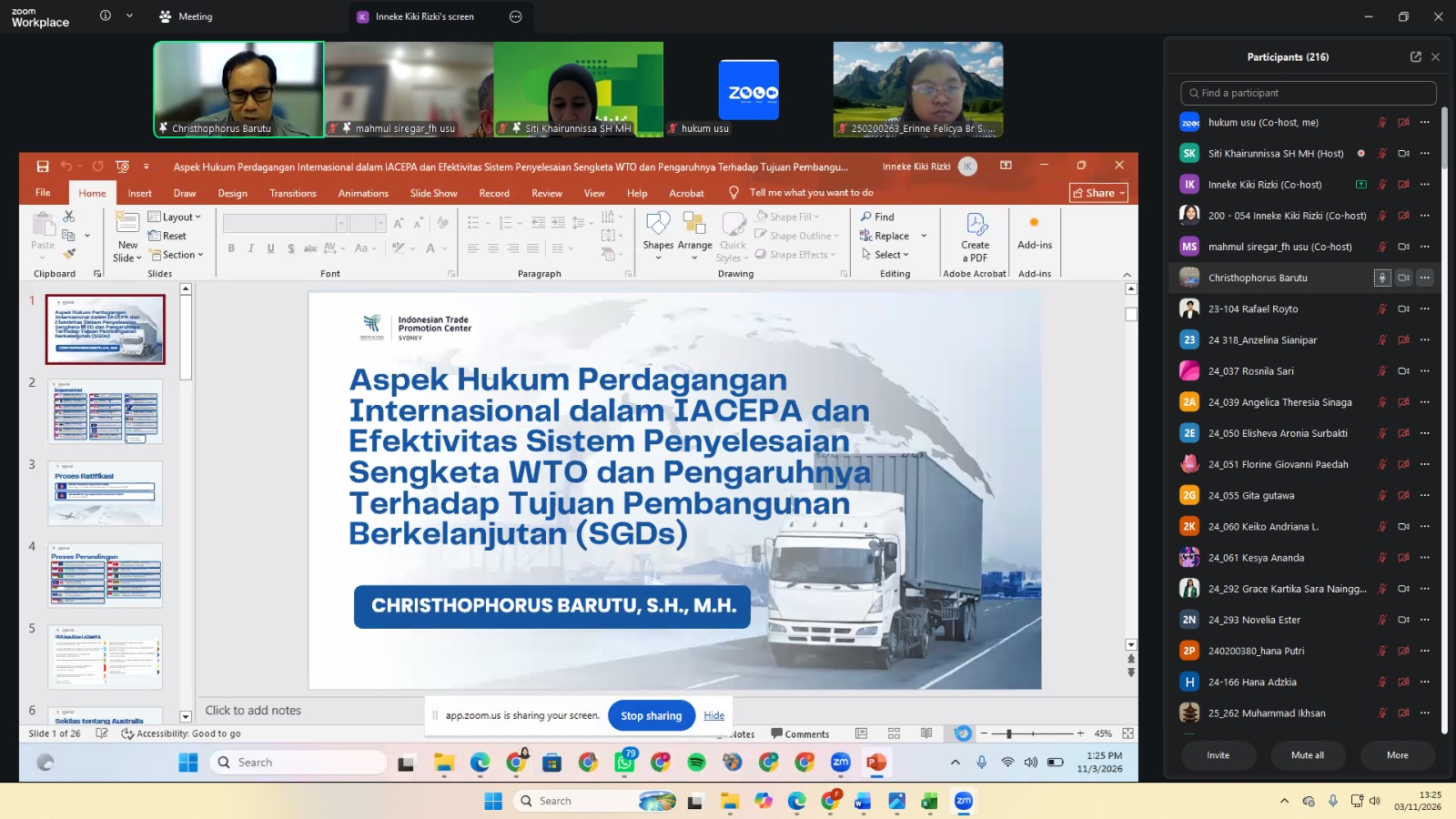
The discussion of the WTO dispute settlement mechanism was one of the key focuses of this event. The multilateral trade dispute settlement system plays a role in providing legal certainty for member countries and ensuring the implementation of international trade commitments. Amid the various challenges facing the global trading system, understanding the effectiveness of these mechanisms has become increasingly relevant, particularly for developing countries such as Indonesia.
In addition to the WTO dispute settlement mechanism, the seminar also addressed the implementation of IA-CEPA in strengthening trade relations between Indonesia and Australia. The agreement, which entered into force on July 5, 2020, opens up broader opportunities for economic cooperation while also presenting challenges in adjusting national trade policies and regulations to international commitments.
Issues concerning product standardization, non-tariff trade barriers, market access, and compliance with international trade agreements are relevant aspects to examine in understanding the implementation of IA-CEPA. These issues demonstrate that international trade is not only related to economic activities but also requires legal certainty and a regulatory framework capable of accommodating national interests.
The presence of Christhophorus Barutu, S.H., M.H., as both a practitioner and an alumnus of the Faculty of Law, USU, provided added value to the development of knowledge in international trade law. His professional experience as a trade negotiator at the Ministry of Trade of the Republic of Indonesia served as a bridge between the theoretical understanding gained through legal education and the practice of international trade negotiations.
The seminar, moderated by Siti Khairunnissa, S.H., M.H., also reflected the importance of academic involvement in facilitating the exchange of ideas between practitioners and the university environment. Through this academic forum, students are expected to gain a more comprehensive understanding of the application of international trade law and career development opportunities in economic diplomacy and trade negotiations.
Furthermore, the organization of this seminar underscored the importance of synergy between higher education institutions, alumni, and government institutions in supporting the development of legal education that is responsive to global changes. This collaboration is expected to enrich the learning process while encouraging the development of academic studies that contribute to Indonesia's trade policies.
Through this Academic Development Seminar, the Faculty of Law, Universitas Sumatera Utara, continues to strengthen its commitment to developing an academic environment oriented toward mastery of legal knowledge, practitioner involvement, and improvement of students' competencies in facing the dynamics of international trade law and sustainable development.